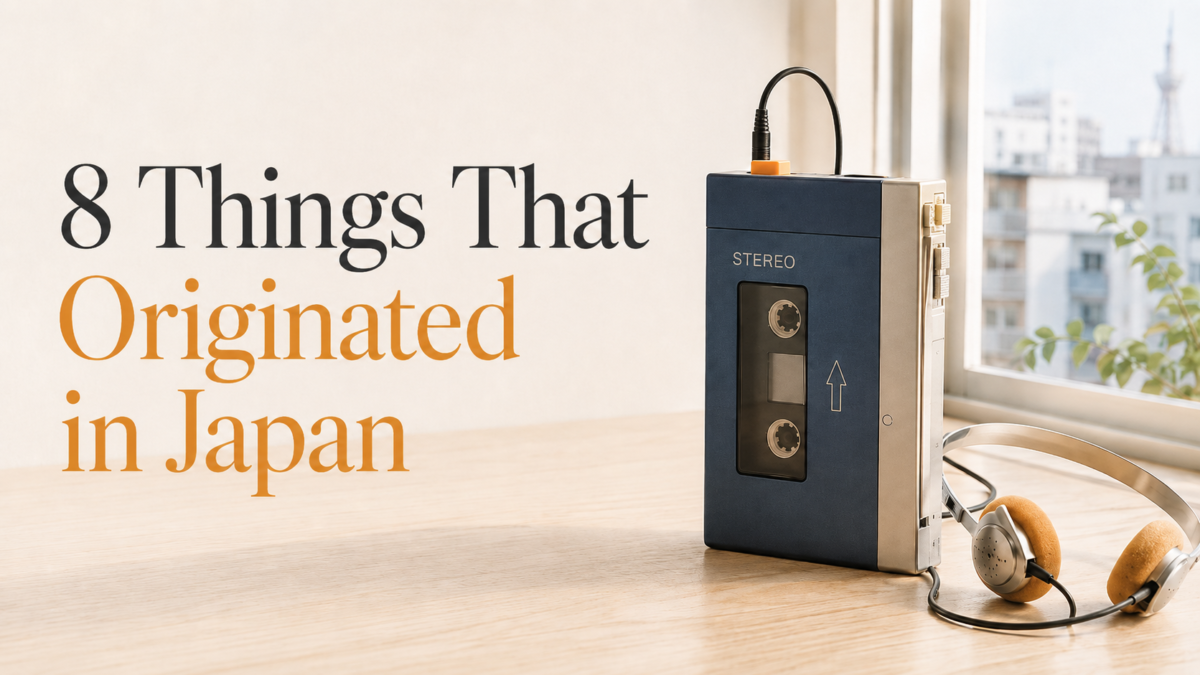
Scanning a QR code, listening to music through earphones, or eating instant noodles.
These are ordinary parts of everyday life in many parts of the world today. But some of them were born in Japan before spreading far beyond it.
When people hear “Japanese inventions,” they may imagine robots or advanced electronics. In reality, many ideas began with much more ordinary questions:
Could food be made easier to prepare?
Could information be read faster?
Could people listen to their favorite music outside the home?
Could someone who missed the last train find an inexpensive place to sleep?
In this article, I want to look at eight things that originated or developed in Japan—not simply as a list of Japanese inventions, but by asking why they were needed and how they eventually became part of everyday life.
Convenience First: Instant Noodles and QR Codes
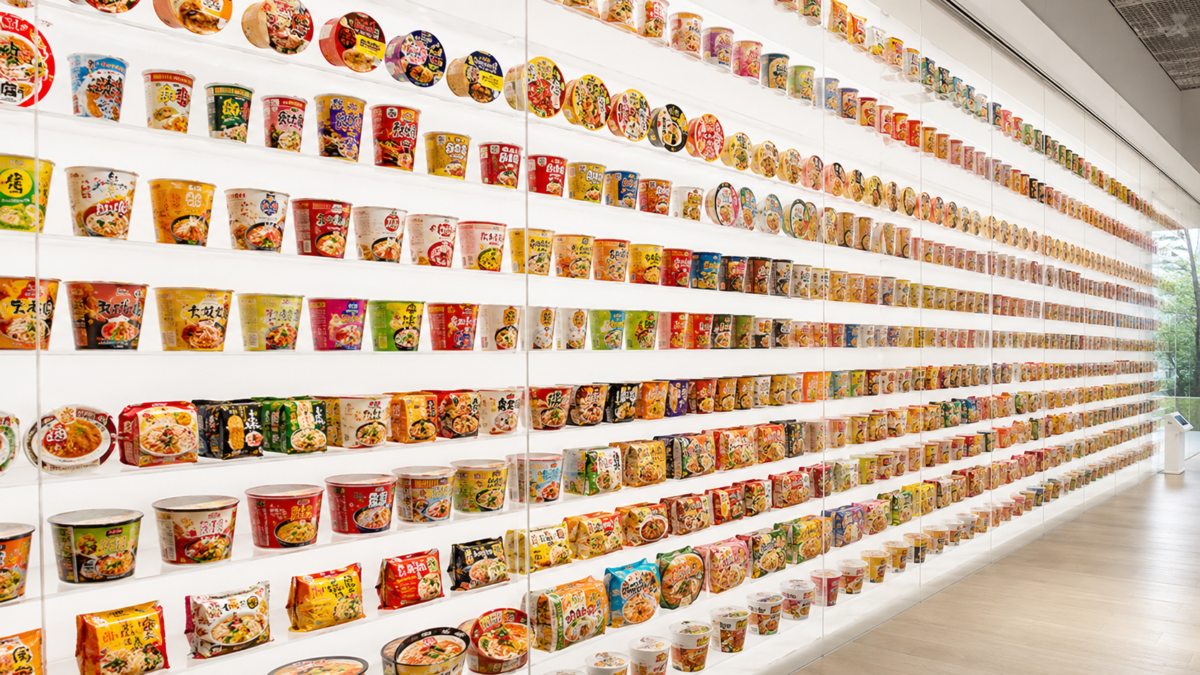
Instant Noodles — 1958
On August 25, 1958, Nissin Foods founder Momofuku Ando launched Chicken Ramen, which Nissin describes as the world’s first instant noodles.
Ando was not simply trying to create a new flavor of ramen.
After seeing people searching for food in postwar Japan, he became deeply aware of the importance of food and worked toward something that could be stored and prepared easily.
The result was a method of drying noodles by frying them in oil, allowing them to soften again quickly when hot water was added.
Instant noodles are now eaten around the world, but in Japan, Nissin products are still an ordinary sight on supermarket and convenience store shelves.
I have certainly relied on them many times myself.
My favorite is the standard Cup Noodles flavor, although the curry version is difficult to resist too. I have also always liked U.F.O., Nissin’s cup-style yakisoba.
There is something interesting about the fact that a food that became global still feels completely ordinary in Japan—a simple option for those days when you want something quick.
QR Codes — 1994
QR codes were not originally created so that people could make smartphone payments or open restaurant menus.
They were developed by DENSO WAVE in 1994 for managing automobile parts during production.
As manufacturing moved toward producing a wider variety of products in smaller quantities, factories needed a way to store more information in less space and read it more quickly than conventional barcodes allowed.
The QR code emerged as an answer to that practical problem.
Its use eventually spread far beyond factories. Today, QR codes are used for payments, tickets, advertising, websites, and many other everyday purposes.
I use them constantly too.
I scan QR codes on flyers to open websites and use them for accessing or issuing tickets. Typing a web address manually is something I hardly think about anymore.
You simply point your phone at a small square.
It has become so ordinary that it is easy to forget how convenient the idea really is.
Instant noodles and QR codes are very different inventions, but their starting points have something in common:
Could an inconvenience right in front of us be made a little simpler?
Some ideas born in Japan began with questions as small as that.
Changing Everyday Habits: Walkman and Emoji
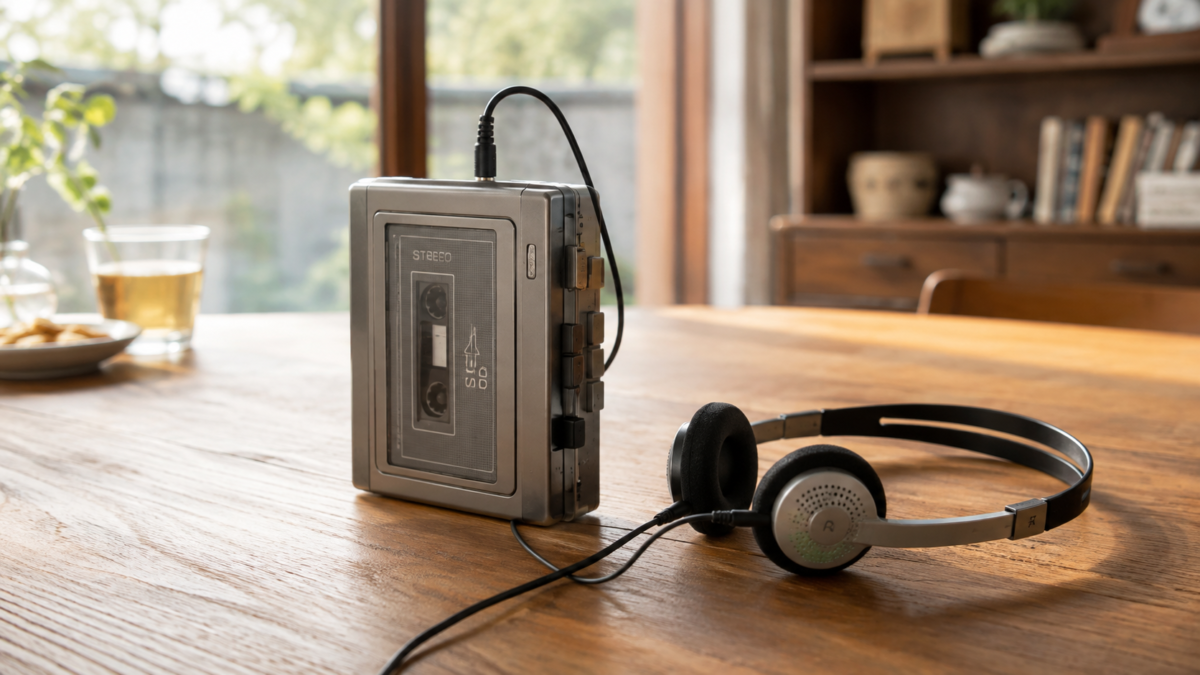
Walkman — 1979
Sony launched the first Walkman, the TPS-L2, on July 1, 1979.
Portable audio equipment existed before the Walkman. What Sony proposed, however, was not primarily a machine for recording sound.
It was a device designed to let one person take music with them and enjoy it wherever they wanted.
According to Sony, one of the inspirations came from co-founder Masaru Ibuka, who wanted to listen to stereo music during long airplane journeys.
At first, the idea of walking through a city while wearing headphones was itself unusual.
But the Walkman eventually spread around the world and helped establish a new habit: listening to your own music wherever you happened to be.
I also used Sony portable music players.
Being able to leave home, get on a train, walk through the city, and keep listening to the music I liked felt genuinely groundbreaking at the time.
Smartphones eventually replaced dedicated portable music players for many people, but I still remember the impressive sound quality of Sony players and how effective their noise-canceling earphones were.
The device has changed, but the habit remains:
walking through the world with your own personal soundtrack.
Emoji — 1990s
Emoji require a little more careful explanation.
Rather than saying that one Japanese person simply “invented the world’s first emoji,” it is more accurate to say that the systems that led to today’s emoji culture developed and became widespread through Japan’s mobile phone culture in the 1990s.
By the end of the 1990s, emoji were available on Japanese mobile phones, and different Japanese carriers had their own sets.
On the small screens of early mobile phones, tiny pictures could help communicate emotions and nuances that short text messages did not always express easily.
What began within Japanese mobile communication eventually spread into a global form of communication.
This is easy to understand from my own daily life.
I use emoji almost every day, whether I am chatting with someone or posting on social media.
Using symbols such as 😊 or ❤️ no longer feels unusual at all.
Something that grew through Japanese mobile phone culture is now used naturally across languages.
Solving Urban Life: Shinkansen and Capsule Hotels
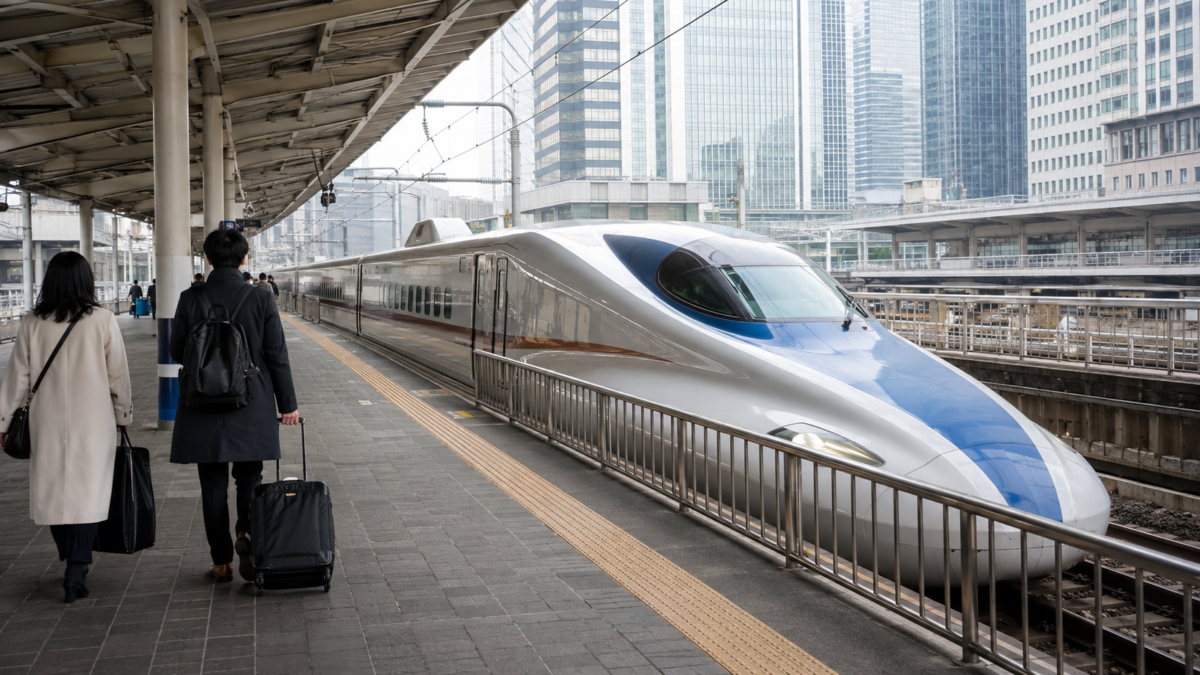
Shinkansen — 1964
On October 1, 1964, the Tokaido Shinkansen opened between Tokyo and Osaka.
JR Central describes it as the world’s first full-scale high-speed railway system.
What mattered about the Shinkansen was not simply that Japan built a fast train.
It created an entirely new transportation system capable of moving large numbers of people quickly and reliably between major cities such as Tokyo, Nagoya, and Osaka.
When it opened in 1964, the journey between Tokyo and Osaka took about four hours. The system continued to become faster in the decades that followed.
For visitors, the Shinkansen may seem like one of Japan’s famous high-speed trains. For people living in Japan, however, it is also a practical form of transportation used for business trips, visiting family, and holidays.
I live in Osaka, so I feel that convenience quite directly.
Tokyo is roughly 500 kilometers away, yet the fastest Shinkansen services can cover the journey in around two and a half hours.
The fare varies depending on the train and seat, but it is around ¥15,000 one way.
Driving the same distance can easily take more than eight hours.
Being able to leave Osaka in the morning and arrive in Tokyo before lunchtime is something that can start to feel normal when you live here, but when I think about it again, it is remarkable.
Rather than a futuristic attraction, the Shinkansen has become part of Japan’s everyday infrastructure.
I have written separately about why the Shinkansen is so reliable and how the system manages such consistent operations.
Capsule Hotels — 1979
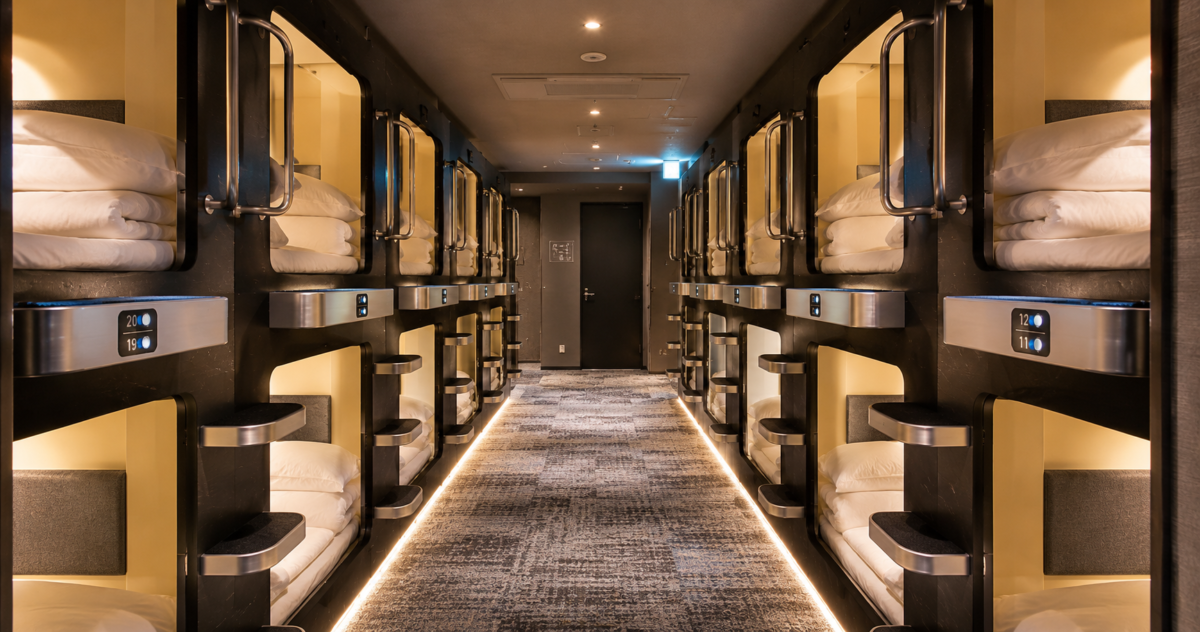
Another idea that emerged from Japanese urban life is the capsule hotel.
The world’s first capsule hotel opened in Umeda, Osaka, in 1979.
It originally provided a relatively inexpensive place to spend the night for people such as office workers who had missed the last train.
The concept is simple: each guest receives a compact sleeping space, while facilities such as showers and toilets are shared.
From overseas, capsule hotels can look like an unusually futuristic form of accommodation. But the idea behind them is very practical.
In a city where space is limited, provide only the amount of private sleeping space that a person actually needs.
Today, many capsule hotels have become more comfortable and design-conscious, and travelers can experience them during a visit to Japan.
But they did not suddenly appear simply because Japan wanted to create a “futuristic hotel.”
Behind the concept were limited urban space, a railway-centered lifestyle, and the very specific need for somewhere to sleep for one night.
Entertainment and Communication: Karaoke
Karaoke — 1970s
Among things that originated in Japan, “karaoke” may be one of the Japanese words most widely understood around the world.
The history of karaoke involves several people and different machines, so it is better not to reduce the story to a claim that one person invented absolutely everything.
Still, Daisuke Inoue is widely recognized as an important figure in karaoke’s development.
As a young musician in Kobe, he played accompaniment for customers singing in bars and other establishments.
Eventually, he created a system that allowed people to sing along to recorded backing music without needing a live musician.
What emerged was more than another music player.
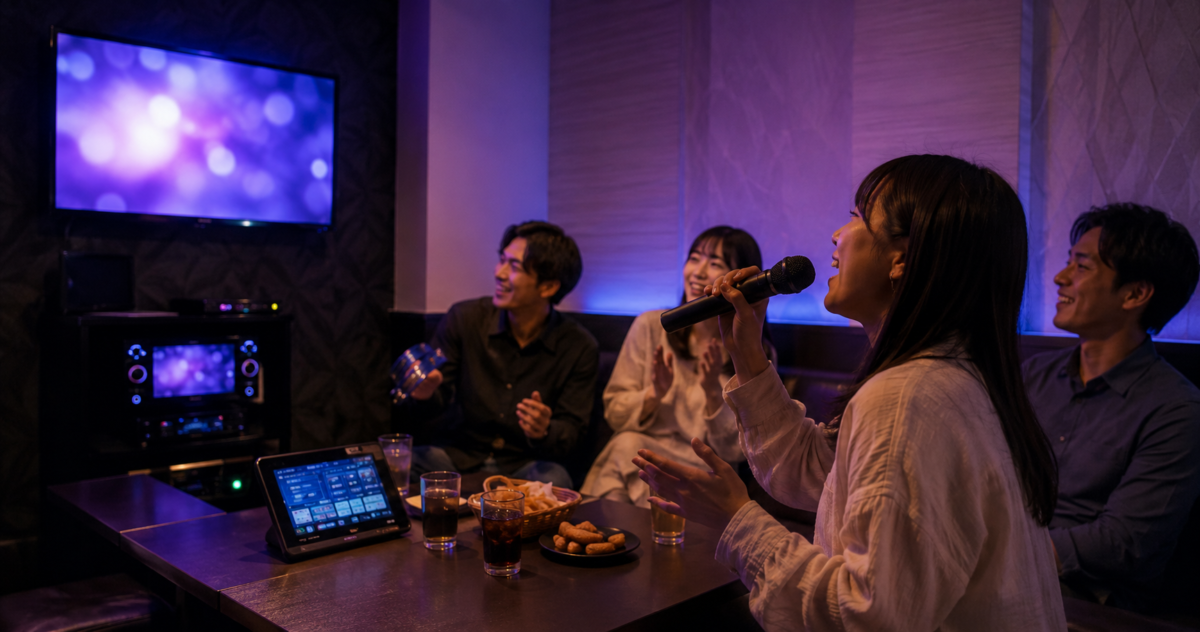
It created a way for ordinary people—not professional singers—to choose a song and make singing itself part of the entertainment.
In Japan, karaoke later moved from bars and snack lounges into private karaoke boxes. Today, people use them with friends, after work parties, with family, and even alone.
Karaoke shops remain common in Japanese cities and are relatively easy for visitors to use.
The fact that the Japanese word karaoke itself is understood around the world shows how far the culture has traveled.
I have written a separate article about why karaoke became so popular in Japan, so I will leave the deeper cultural story there.
The Invention You Rarely Notice: Blue LEDs
The final example is much less visible than instant noodles or karaoke.
It is the efficient blue LED.
Red and green LEDs already existed, but creating a bright and efficient blue LED remained a major technological challenge for many years.
During the 1980s and 1990s, Isamu Akasaki, Hiroshi Amano, and Shuji Nakamura made the breakthroughs that led to efficient blue LEDs.
The three were awarded the 2014 Nobel Prize in Physics for this work.
Why did blue matter so much?
Once efficient blue LEDs became practical, they made it possible to create bright, energy-efficient white light, including by combining blue LEDs with phosphors.
Related technology is now used in LED lighting, displays, and many kinds of electronic devices.
Of everything in this article, this is probably the invention I consciously notice the least in daily life.
I never think, “I used a blue LED today.”
But I use a computer and smartphone every day and live surrounded by LED lighting. When I consider that, it is difficult to imagine modern life completely separated from the technology.
Perhaps becoming almost invisible is one sign that an invention has fully entered everyday life.
The eight examples in this article range from food and transportation to entertainment and electronics.
Yet when we look at how they began, there are some common themes.
Make food easier to prepare.
Handle information faster.
Listen to music wherever you want.
Travel quickly between major cities.
Use limited urban space efficiently.
Let ordinary people enjoy singing.
They did not all begin with a grand declaration that they would change the world.
They began with specific problems in everyday life and attempts to solve them in a slightly different way.
Some of those solutions eventually crossed borders and became ordinary parts of life around the world.
Looking back at these eight examples, I also realized how many of them I use myself without thinking about where they came from.
I eat instant noodles, scan QR codes, send emoji, and ride the Shinkansen.
I do not think of myself as “using Japanese inventions.”
I use them because they are convenient, enjoyable, or necessary.
Perhaps that is true for people around the world as well.
Learning about things that originated in Japan is not simply about memorizing a list of inventions.
It is also a way to see what kinds of inconveniences people faced in Japan at different times, what kind of lives they wanted, and how they tried to turn solutions into something practical.
And sometimes, those solutions quietly become part of the world’s idea of what is normal.