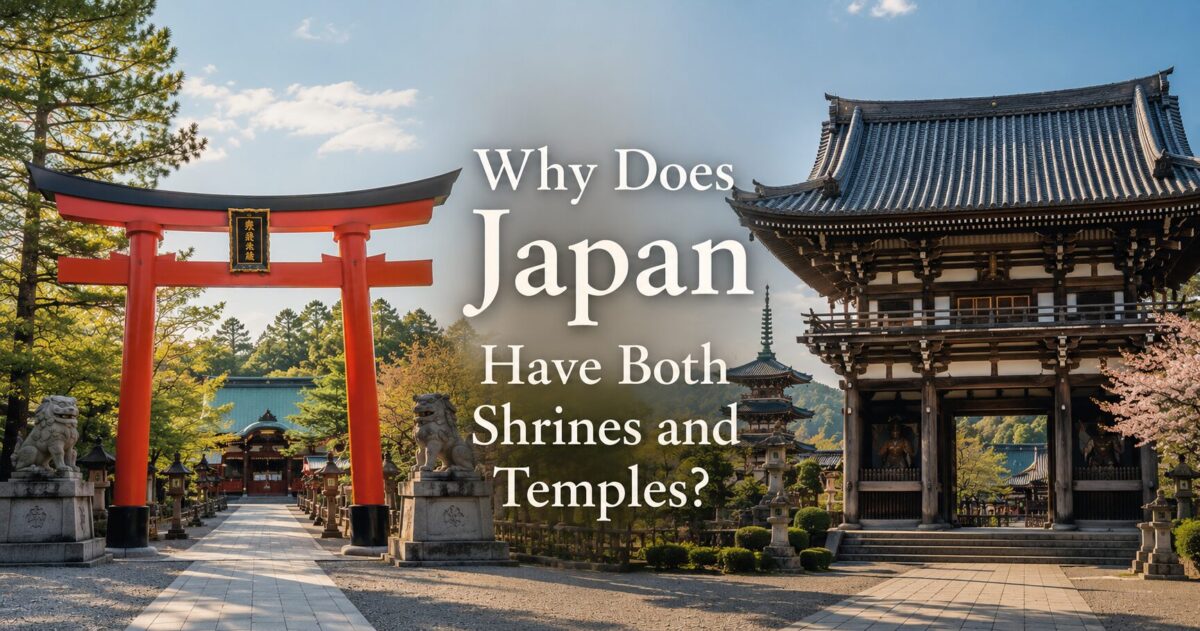
When traveling through Japan, you will often see Shinto shrines marked by red torii gates and Buddhist temples with large wooden gates and statues of the Buddha.
They are not limited to famous tourist destinations. Shrines and temples can be found in residential neighborhoods, near train stations, at the foot of mountains, and in many other ordinary places. They blend naturally into the everyday scenery of Japan.
This often raises several questions among international visitors.
What is the difference between a shrine and a temple?
Which religion do Japanese people follow?
And if Japanese people are often described as non-religious, why are there so many religious places?
Simply saying that Japanese people are non-religious does not fully explain Japan’s relationship with religion.
Many Japanese people may not consider themselves deeply religious. Yet they visit shrines for hatsumōde at New Year, welcome their ancestors during Obon, and often hold Buddhist funerals when a family member dies.
In Japan, religion is often experienced less as a clear declaration of faith and more through seasonal events, family traditions, and important stages of life.
- What Is the Difference Between a Shrine and a Temple?
- Who Do People Pray to at Shinto Shrines?
- Why Do Japanese People Visit Both Shrines and Temples?
- Does “Non-Religious” Mean Having No Religion?
- How Does Shinto Remain Part of Everyday Life?
- How Has Buddhism Influenced Everyday Life in Japan?
- Shinto and Buddhism Once Existed Side by Side
- How Do You Visit a Shrine or Temple Respectfully?
- Shrines and Temples Are More Than Tourist Attractions
What Is the Difference Between a Shrine and a Temple?
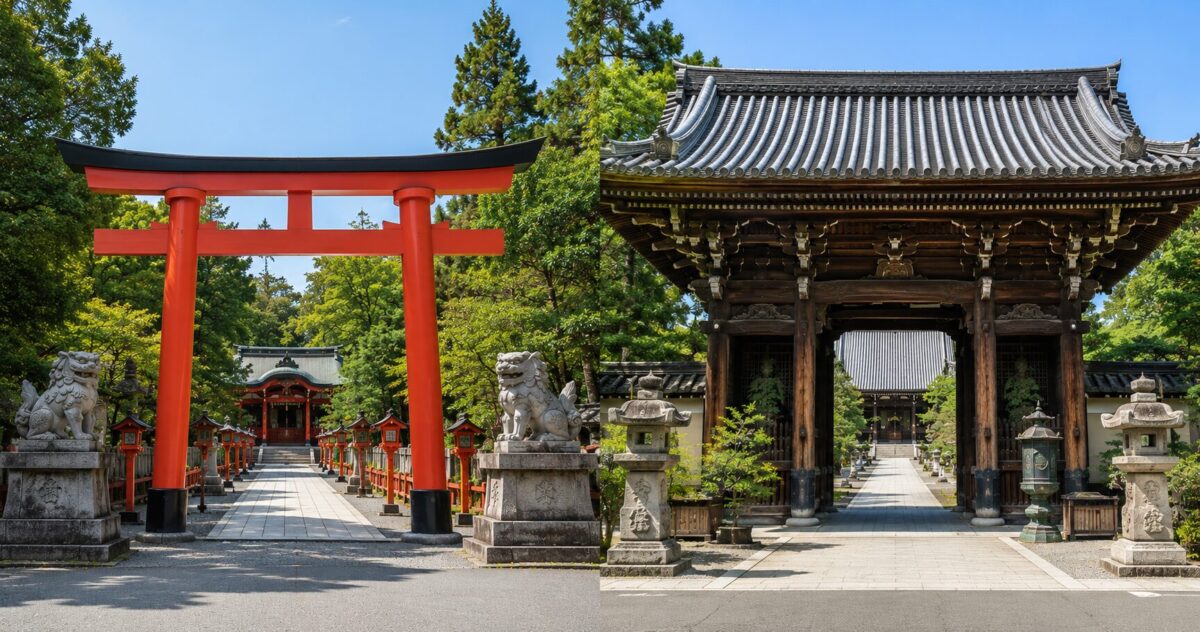
Shrines and temples can sometimes look similar, but they belong to different religious traditions.
A shrine is a place of Shinto, the indigenous religious tradition of Japan. Shrines are dedicated to sacred beings known as kami.
A temple, on the other hand, is a place of Buddhism. Temples usually contain Buddhist statues, and Buddhist monks conduct prayers, training, funerals, and memorial services there.
The entrance is often the easiest way to tell them apart.
If you see a torii gate, the site is usually a shrine. You may also find a sacred rope called a shimenawa, guardian statues known as komainu, a purification basin, and a worship hall.
If you see a large temple gate, Buddhist statues, a bell, or an incense burner, the site is likely to be a temple.
However, appearance alone does not always provide a perfect answer.
Shinto and Buddhism were closely connected for centuries in Japan, and some older religious sites still contain features of both traditions.
Who Do People Pray to at Shinto Shrines?
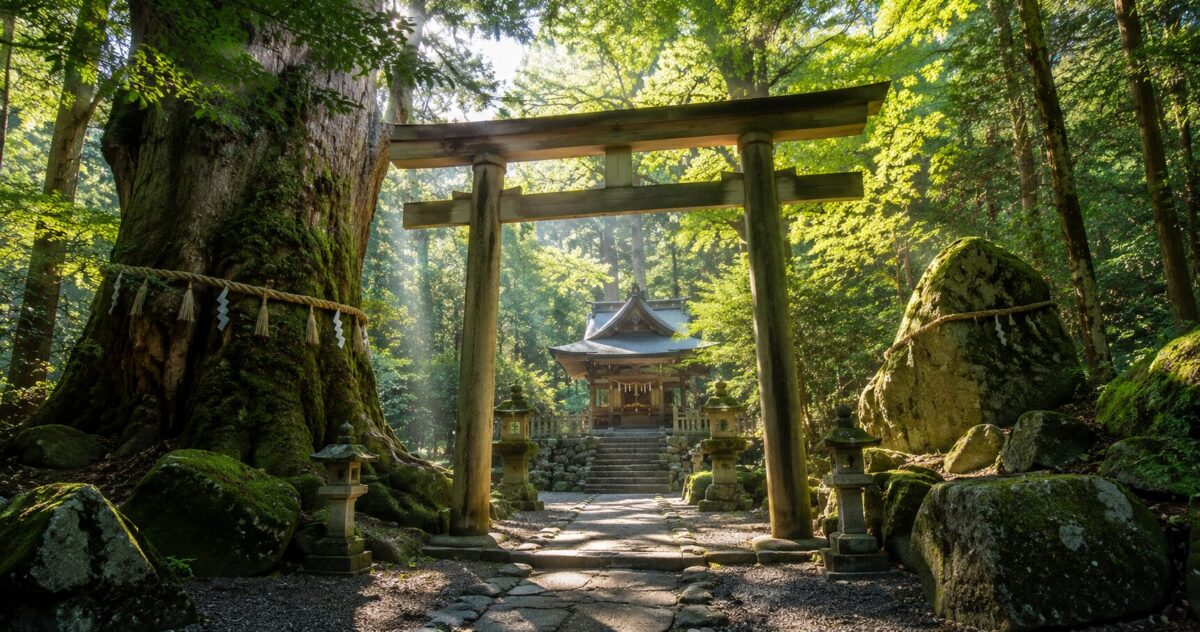
In Shinto, sacred power has traditionally been associated with many parts of the natural world, including mountains, seas, rivers, trees, rocks, and waterfalls.
This worldview is often expressed through the phrase yaoyorozu no kami.
Yaoyorozu does not literally mean that there are exactly eight million gods. It suggests that there are countless kami.
Different shrines are dedicated to different kami.
Some are believed to protect a local community. Others are connected with agriculture, business, learning, the sea, mountains, or important historical figures.
For this reason, people may visit different shrines depending on what they are hoping for.
Students may visit a shrine associated with learning before an important examination. Business owners may pray at a shrine known for prosperity. Other visitors may pray for safe travel, a healthy pregnancy, protection from misfortune, or good health.
Why Do Japanese People Visit Both Shrines and Temples?
From outside Japan, being involved with both Shinto and Buddhism may seem unusual.
In Japan, however, there is often less pressure to choose only one of them.
Shrines are commonly associated with new beginnings, celebrations, wishes, and important moments of growth.
Typical shrine-related customs include hatsumōde, the first shrine visit of the New Year, Shichi-Go-San celebrations for children, prayers for a safe pregnancy, protection from bad luck, success in examinations, and Shinto wedding ceremonies.
Temples, meanwhile, are closely associated with remembering ancestors and mourning the dead.
Buddhist customs are especially visible at funerals, memorial services, visits to family graves, and during Obon.
I also visit my local shrine on January 1 every year for hatsumōde.
During Obon, which is observed in many areas around August 13 to 16, my family remembers our ancestors with mukaebi and okuribi, small fires traditionally used to welcome ancestral spirits and later send them off. When a relative passed away, we held a Buddhist funeral.
At none of these moments did I consciously think, “Today I am following Shinto,” or “Now I am following Buddhism.”
They simply felt like familiar family and community customs.
I do not think this feeling is unique to me. For many Japanese people, shrines and temples are not competing religious choices. They are places that accompany different moments in life.
Does “Non-Religious” Mean Having No Religion?
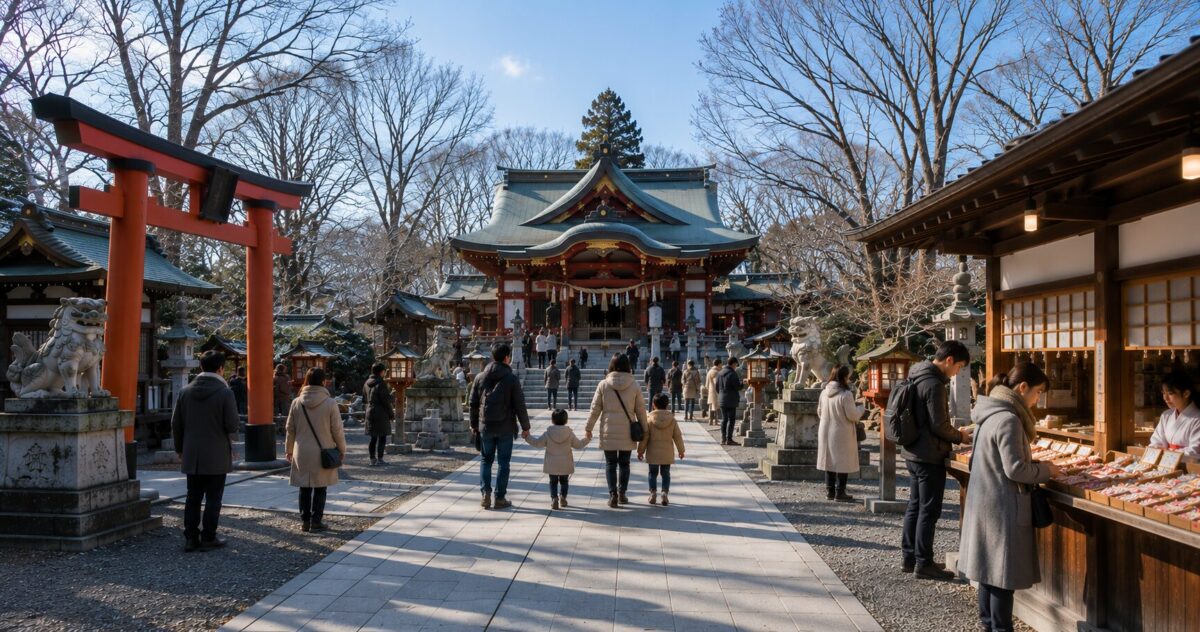
If you ask Japanese people about their religion, many will answer, “None,” or say that they are non-religious.
However, this does not necessarily mean that religion plays no role in their lives.
In most cases, saying “I’m not religious” simply means that a person does not belong to a specific religious organization or does not consciously practice a particular faith in everyday life.
Even so, many people visit shrines at New Year, carry protective charms called omamori, take part in local festivals, visit family graves during Obon and the equinox holidays, and hold Buddhist funerals when a family member passes away.
In other words, even if religion is not something people actively think about, customs and values that originated from Shinto and Buddhism remain part of everyday life.
In Japan, religion has traditionally been passed down not only as a matter of belief, but also as a way of marking the changing seasons and important moments in life.
How Does Shinto Remain Part of Everyday Life?
Rather than focusing on written scriptures, Shinto developed through people’s relationship with nature and their local communities.
Mountains, ancient trees, rocks, and waterfalls are often regarded as sacred places. The forests surrounding many shrines, known as chinju no mori (sacred shrine forests), are one example of this tradition.
Purification is another important element of Shinto.
Before entering a sacred space, visitors often cleanse their hands and mouth at a purification basin called a temizuya. Priests may also perform purification rituals before important ceremonies. These customs reflect the idea of approaching the kami in a pure and respectful state.
Japan is often associated with cleanliness, but it would be too simplistic to explain this entirely through Shinto. Education, public health, and community values have also played significant roles.
Even so, respect for nature, places, and cleanliness is often seen as one of the ways Shinto has influenced Japanese culture.
Local festivals provide another easy-to-see example.
Many festivals originally began as ceremonies to thank the local kami or to pray for a good harvest, safety, and prosperity. Today, many participants simply enjoy them as community events, yet these traditions continue to connect neighborhoods across Japan.
How Has Buddhism Influenced Everyday Life in Japan?
After Buddhism was introduced to Japan, it influenced not only funerals and memorial services but also Japanese art, architecture, literature, and food culture.
In everyday life, Buddhism is most closely associated with remembering the dead and honoring ancestors.
During Obon, many families believe that the spirits of their ancestors return home. People visit family graves, make offerings at household Buddhist altars, and in some regions light mukaebi to welcome the spirits and okuribi to send them off again.
Buddhism also teaches the concept of shogyō mujō, often translated as the impermanence of all things.
Japanese people often find beauty not only in cherry blossoms at their peak, but also in the moment when the petals begin to fall. This appreciation comes from many influences, including Japan’s natural environment and literary traditions, but it also shares similarities with the Buddhist acceptance that everything changes.
Another familiar Buddhist idea is cause and effect, the belief that one’s actions eventually bring corresponding consequences.
At the same time, sayings such as “Don’t do bad things even if no one is watching,” “You’ll receive divine punishment,” or “Heaven is watching” reflect a mixture of Buddhist teachings, Shinto beliefs, folk traditions, and family values.
For this reason, it is difficult to separate the influence of Shinto and Buddhism completely in everyday Japanese life.
Shinto and Buddhism Once Existed Side by Side
One reason why shrines and temples coexist so naturally in Japan is a long historical tradition known as Shinbutsu-shūgō, the blending of Shinto and Buddhism.
When Buddhism arrived in Japan, it did not replace the existing worship of the kami.
Instead, the two traditions gradually became interconnected. In many places, shrines and temples stood within the same grounds, and some people believed that the kami were manifestations of Buddhas appearing to guide the people of Japan.
Today, shrines and temples are generally treated as separate religious institutions.
However, for much of Japanese history, the boundary between them was far less distinct.
During the Meiji period, the government introduced policies to formally separate Shinto and Buddhism. Although the institutions became legally distinct, everyday customs did not change overnight.
The modern practice of visiting a shrine on New Year’s Day while holding Buddhist funerals reflects centuries of coexistence between the two traditions.
How Do You Visit a Shrine or Temple Respectfully?
The basic way of paying your respects is slightly different at shrines and temples.
At a Shinto shrine, visitors usually bow lightly before passing through the torii gate.
If there is a temizuya (purification basin), they rinse their hands and mouth before approaching the main worship hall. After making an offering, the most common etiquette is two bows, two claps, and one final bow.
However, customs vary from shrine to shrine, so it is always best to follow any instructions posted on the grounds.
At a Buddhist temple, visitors also bow lightly before entering through the main gate.
If an incense burner is available, people may offer incense, although this is not required at every temple.
In the main hall, visitors quietly put their hands together in prayer. Unlike at shrines, clapping is generally not part of Buddhist worship.
More important than remembering every detail of the etiquette is showing respect for the place.
Speaking quietly, avoiding disturbing people who are praying, staying out of restricted areas, and following photography rules are all simple ways to show consideration during your visit.
Shrines and Temples Are More Than Tourist Attractions
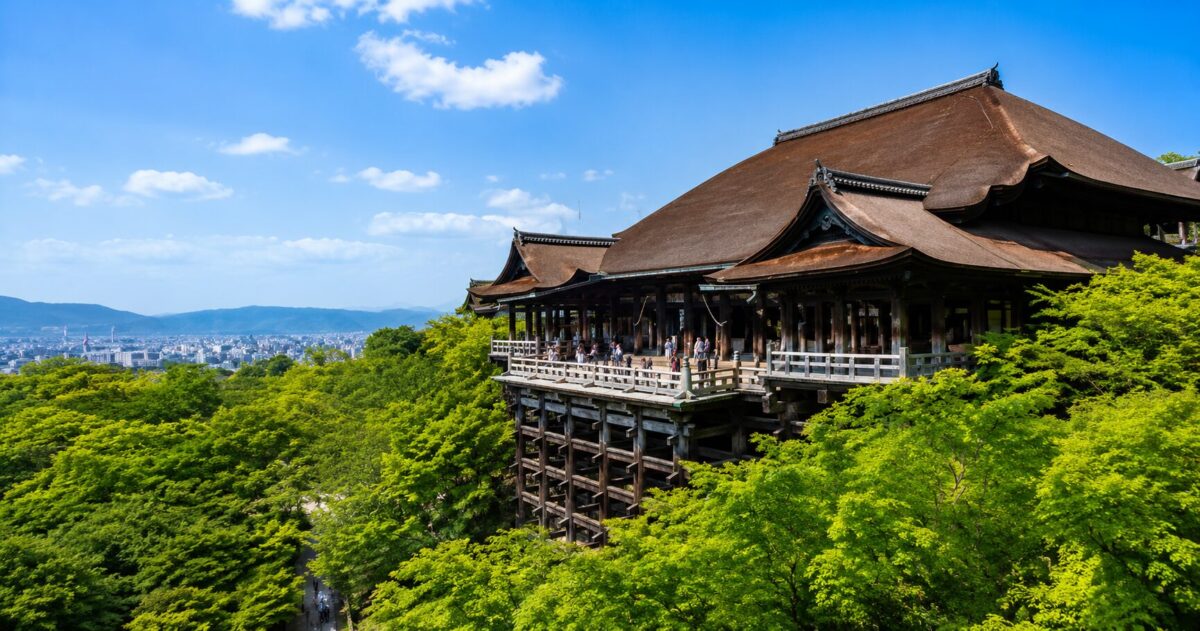
For many visitors, shrines and temples are places to admire beautiful architecture, peaceful gardens, and centuries of history.
They are certainly some of Japan’s most popular tourist attractions.
For Japanese people, however, they are also something more.
People visit shrines to welcome the New Year, celebrate children’s growth during Shichi-Go-San, and pray for good fortune.
Communities gather at local festivals, while families welcome their ancestors during Obon, visit family graves, and remember loved ones who have passed away. At the end of life, many people say goodbye to family members through Buddhist funeral ceremonies.
Not everyone is consciously thinking about religion during these moments.
Even so, shrines and temples quietly accompany the changing seasons, family traditions, community life, and the milestones of everyday living.
Understanding Japan’s religious culture is not about deciding whether Shinto or Buddhism is more important.
It is about recognizing that, for many Japanese people, both naturally exist side by side in everyday life.
Learning the difference between a shrine and a temple is therefore about more than identifying two different kinds of buildings.
It also offers a glimpse into how people in Japan have long connected with nature, remembered their ancestors, strengthened their local communities, and accepted the changing seasons and stages of life.