Sushi, ramen, tempura, yakitori.
Many Japanese food names are now used as they are in English-speaking countries.
But when you stop and look at what those words actually mean in Japanese, some of them become surprisingly interesting.
Why is a bowl of chicken and egg called “parent and child”?
Why does adding an egg to udon turn it into “moon viewing”?
And why does a pork dish contain a word that ultimately came from the Western idea of a cutlet?
Food names are more than labels.
Some describe the ingredients or cooking method directly. Others preserve sounds, visual images, foreign words, old tools, religious traditions, and stories from the past.
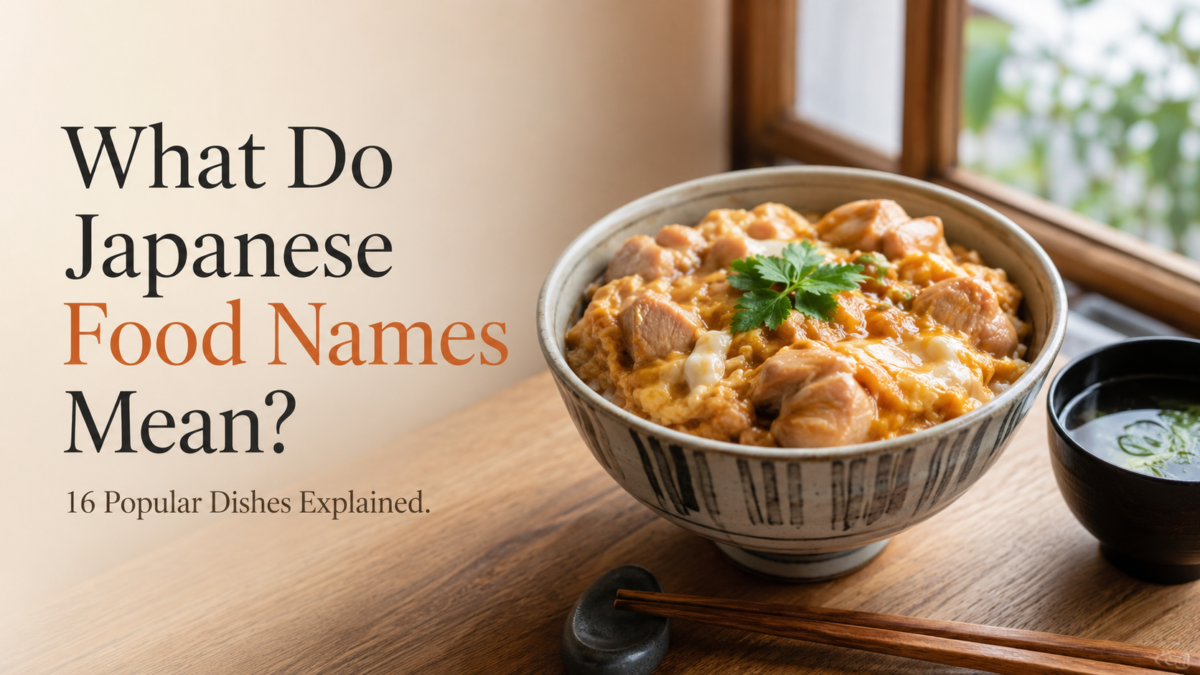
Here are 16 familiar Japanese dishes—not simply as foods to eat, but as examples of how their names came to be.
Some Japanese Food Names Are Surprisingly Literal
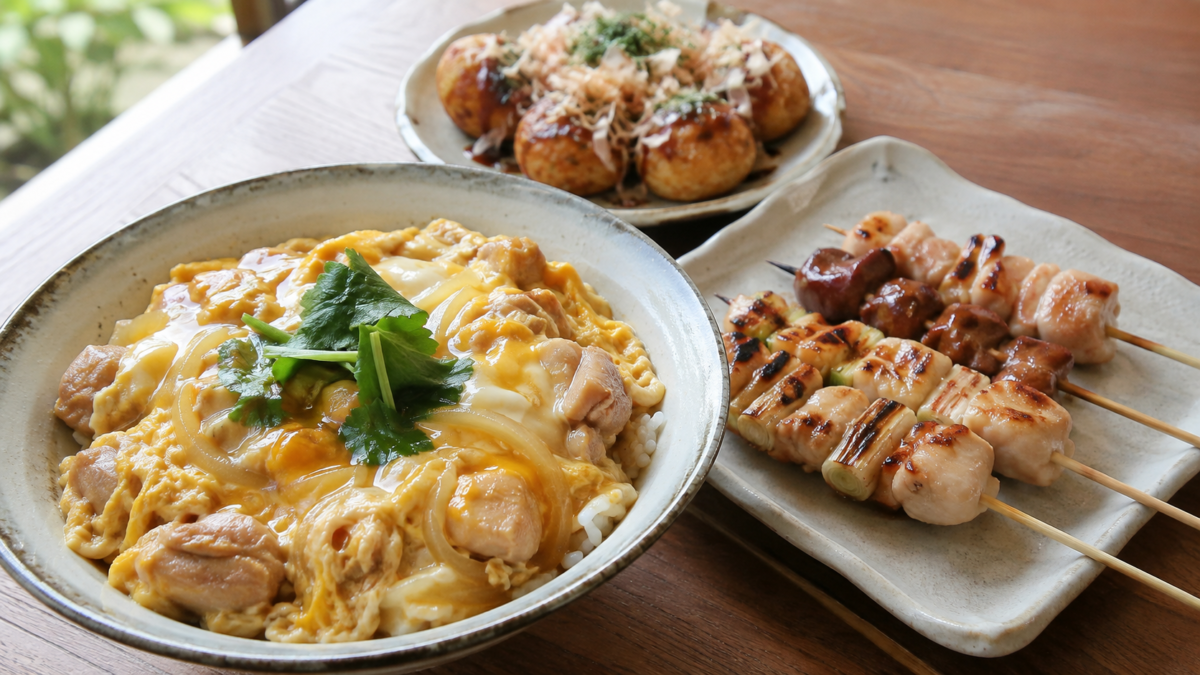
Oyakodon — “Parent-and-Child Bowl”
The name oyakodon can sound a little strange when you first learn what it means.
- oya = parent
- ko = child
- don = rice bowl
Why “parent and child”?
Because the dish combines chicken and egg.
In Tokyo, a dish of chicken simmered with egg was already known as oyakoni in the late 19th century, and it later developed into the rice bowl known as oyakodon. There are several accounts of its exact origin.
Translated literally as “Parent-and-Child Bowl,” it sounds much more humorous than it does to a Japanese speaker who has grown up hearing the name.
Takoyaki — “Grilled Octopus”
Takoyaki is much more straightforward.
- tako = octopus
- yaki = grilled or cooked
In other words, “grilled octopus.”
Of course, the dish itself is a batter-based snack made with pieces of octopus and cooked in a special round mold.
Modern takoyaki developed in Osaka, where octopus began to be used as the filling of an earlier street food called radio-yaki in the early Showa period.
The history may be complicated, but the name itself is wonderfully direct.
Yakitori — “Grilled Bird”
Yakitori is another very literal name.
- yaki = grilled
- tori = bird
In English, yakitori is often described as grilled chicken, and modern yakitori usually refers to chicken.
But the Japanese word tori literally means “bird.”
It is a good example of how the literal meaning of a Japanese food name and the way we naturally translate the dish into English do not always match perfectly.
Katsudon — “Cutlet Rice Bowl”
Katsudon is made from:
- katsu = cutlet
- don = donburi, or rice bowl
So the name is essentially “cutlet rice bowl.”
The most familiar version consists of tonkatsu simmered with egg and seasoning, then served over rice. Regional variations, such as sauce katsudon, also exist.
Here, the name almost explains the structure of the dish by itself.
Tsukemen — “Dipping Noodles”
Tsukemen is just as clear.
- tsuke = dip
- men = noodles
The noodles and concentrated broth are served separately, and you dip the noodles into the broth before eating them.
“Dipping noodles” is therefore a remarkably close translation.
Japanese food names often tell you what you are eating or how you are supposed to eat it.
Some Names Are Built from Wordplay and Hybrid Language
Not every Japanese food name is made entirely from Japanese words.
Some developed as Japan encountered foreign food cultures and reshaped foreign words into something new.
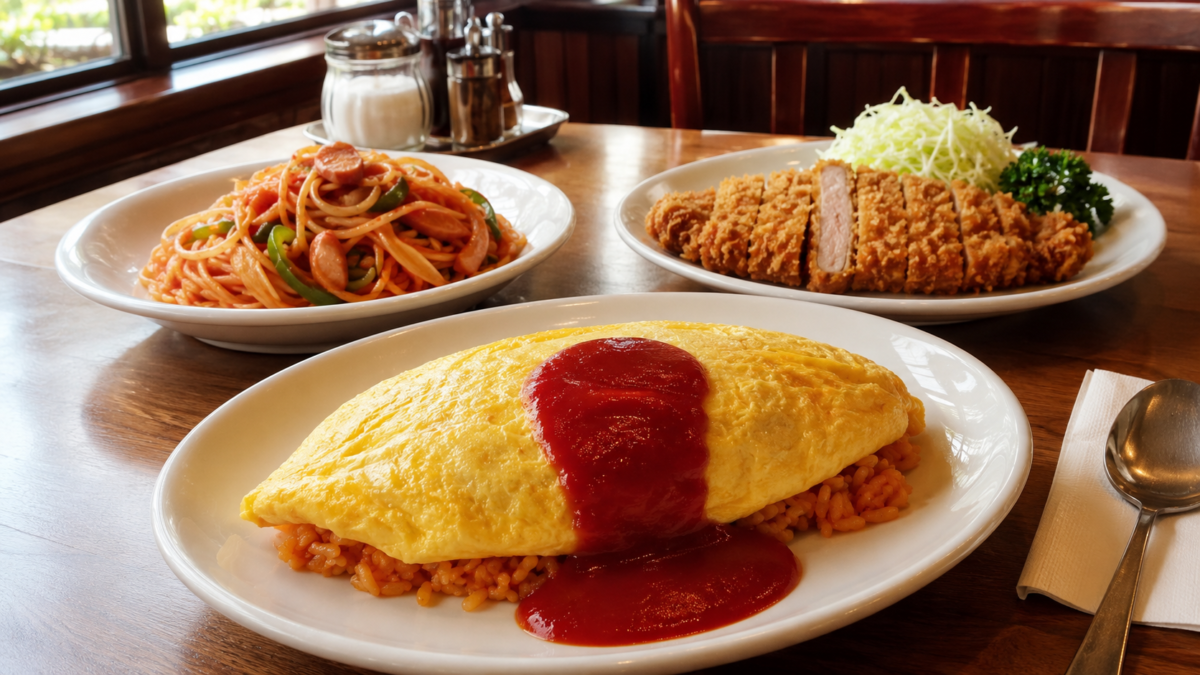
Omurice — Omelet + Rice
The name omurice is almost a little language puzzle.
It combines:
omelet + rice
Omu comes from “omelet,” while rice became raisu in Japanese.
The name itself is a Japanese-made hybrid, just like the dish.
Omurice is one example of yoshoku—Western-influenced food that developed into its own category of everyday Japanese cuisine.
Tonkatsu — Pork + Cutlet
Tonkatsu combines a Japanese word with a Western-derived one.
- ton = pig or pork
- katsu = shortened from katsuretsu
Katsuretsu developed from the Western idea of a cutlet.
Western-style pork cutlets appeared in Japan during the modernization of Japanese cuisine, eventually evolving into the tonkatsu familiar today.
Tonkatsu now feels entirely at home in Japanese everyday food culture, but its name still carries traces of Japan’s encounter with Western cooking.
Napolitan — A Japanese-Style Spaghetti Name
The name Napolitan naturally brings Naples to mind.
But Japanese Napolitan is not simply a traditional pasta dish imported from Naples.
The Hotel New Grand in Yokohama describes its postwar spaghetti Napolitan as one of the dishes created there, inspired by spaghetti eaten by American soldiers and adapted by the hotel’s chef.
Today, ketchup-seasoned Napolitan is closely associated with Japanese cafés and home cooking.
The name sounds international, but the dish developed in Japan.
That is part of what makes yoshoku so interesting.
Tempura — A Name with Portuguese Connections
Tempura is one of the best-known Japanese food words in the world, yet its name may preserve a much older international connection.
Fritter-like cooking techniques introduced by Portuguese visitors in the 16th century are generally considered part of the background to the development of Japanese tempura.
The word itself has several proposed origins.
One theory connects it with the Portuguese tempero. Another links it to words associated with religious periods when eating meat was restricted.
There is no need to reduce the story to one absolute answer.
What matters is that one of Japan’s most familiar food names may still carry traces of Japan’s contact with Portugal centuries ago.
Some Names Come from What the Food Looks or Sounds Like
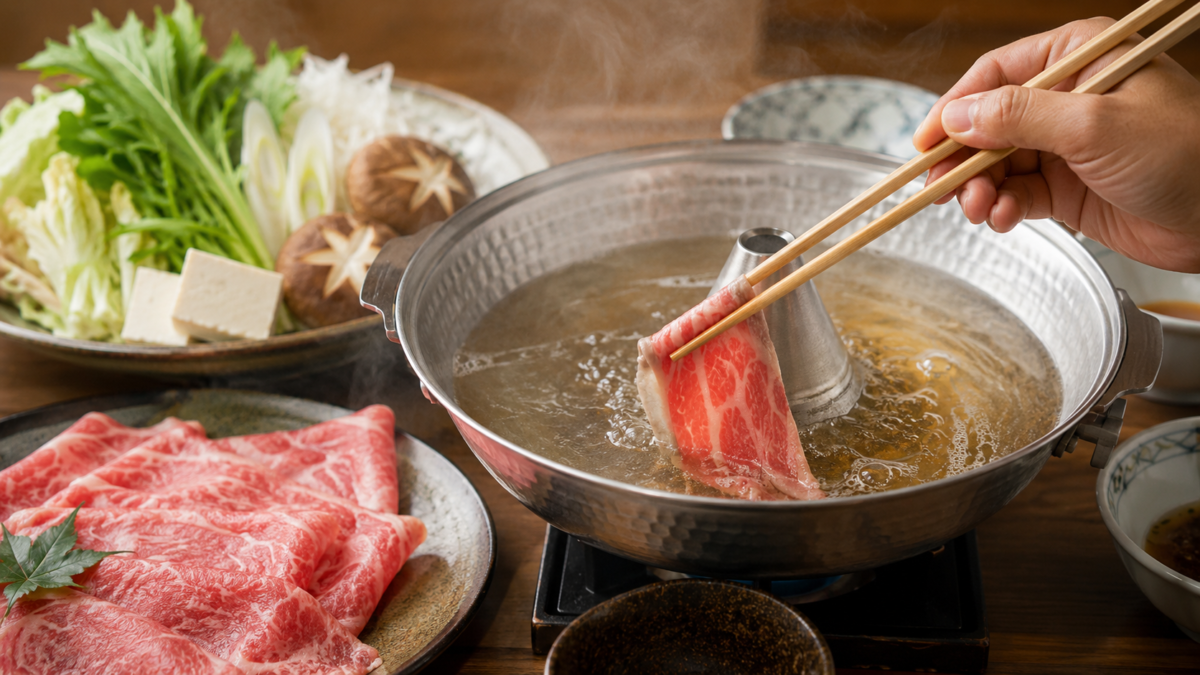
Food names do not always describe ingredients.
In Japanese, sounds and visual images can become names too.
Shabu-shabu — The Sound of Swishing
Shabu-shabu is a particularly good example.
Thin slices of meat are held with chopsticks and moved through hot broth until just cooked.
The name evokes the swishing motion and sound of moving something through water.
It became the name of the dish in Osaka in the early 1950s, and one well-known explanation connects it with the sound of cloth being rinsed through water.
In English, it is sometimes approximated as “swish-swish.”
Here, the action of eating becomes the name of the food.
Tsukimi Udon — “Moon-Viewing Udon”
Tsukimi literally means “moon viewing.”
Japan has a long tradition of appreciating the autumn moon.
In tsukimi udon, the round egg yolk placed on top of the noodles is imagined as the moon.
So “Moon-Viewing Udon” does not mean that you must eat udon while looking at the night sky.
The moon is already in the bowl.
Japanese food often borrows images from nature and the seasons, and tsukimi is a particularly clear example.
Unagi Kabayaki
Kabayaki is eel that is opened, skewered, grilled, and coated with sauce.
But the word kaba is not obvious from the appearance of modern kabayaki.
There are several theories about the name.
One well-known explanation says that eel was once cut into sections and skewered without being opened flat. Its shape resembled the cylindrical flower spike of the gama plant, or cattail.
In other words, an old cooking method may survive today only in the name of the dish.
Food Names Can Preserve Folklore and Old Stories

Some food names preserve even older connections to religion, stories, and everyday tools.
Inari Sushi
Inari sushi consists of vinegared rice stuffed inside seasoned fried tofu.
The name connects the food with Inari worship.
Foxes are traditionally regarded as messengers of Inari, and fried tofu is popularly associated with foxes in Japanese folklore.
Rather than reducing the explanation to “foxes like fried tofu,” it is more useful to see the name as part of a wider cultural link between Inari, foxes, fried tofu, and popular religious tradition.
Kinpira Gobo
The kinpira in kinpira gobo is neither an ingredient nor a cooking technique.
The name is connected to Sakata Kinpira, a powerful fictional character who became popular in Edo-period puppet theater.
Kinpira was portrayed as unusually strong and courageous.
The firmness of burdock root and the spicy seasoning of the dish came to be associated with that strong character.
So hidden inside the name of a simple vegetable side dish is an old popular hero.
Sukiyaki
The suki in sukiyaki may also preserve an image from older everyday life.
One explanation connects the name to the farming tool called a suki, or plow.
In the Kansai region, the metal part of such tools is said to have been used as a makeshift surface for grilling ingredients.
Later, the term became associated with cooking beef.
Modern sukiyaki is prepared in a pot with beef, vegetables, tofu, and other ingredients, so few people would look at it today and imagine a farming tool.
The dish changed. The old image remained in the name.
One Name Can Tell You a Lot About Japanese Food Culture
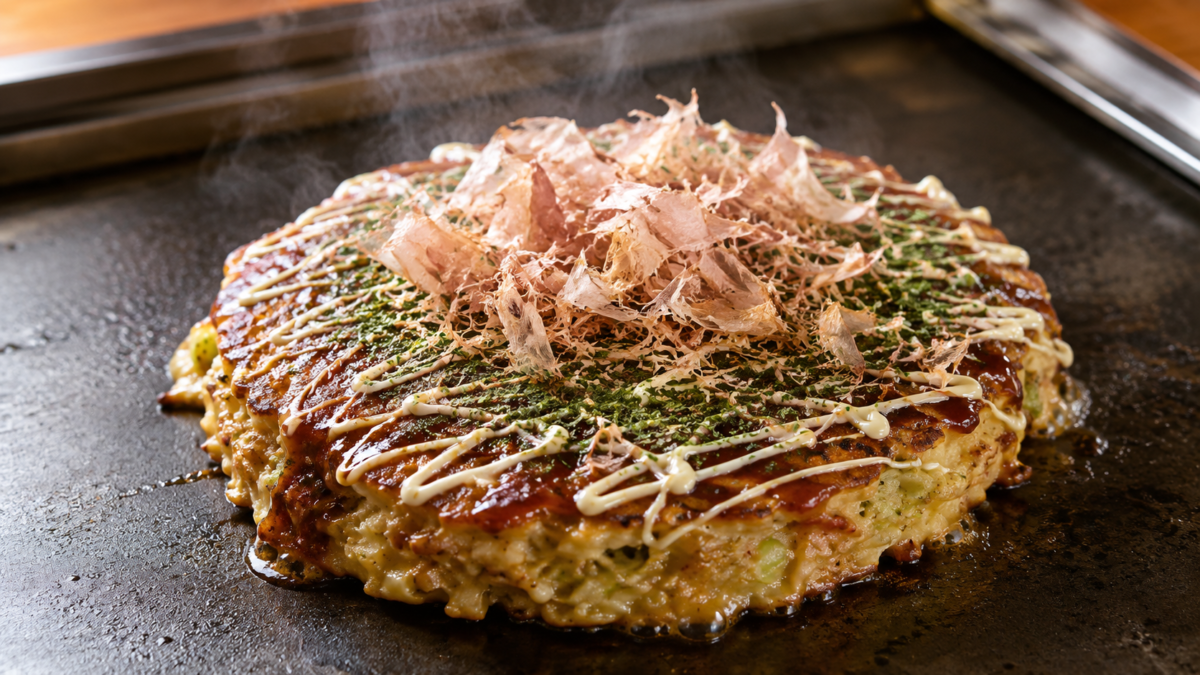
The final example is okonomiyaki.
Okonomiyaki — “Grill What You Like”
Break the name apart and it becomes:
- okonomi = preference, or what you like
- yaki = grilled or cooked
A loose translation would be:
“Grill What You Like.”
That fits the character of the dish rather well.
Cabbage and batter form the base, while pork, seafood, cheese, and other ingredients can be added according to preference.
There are also different regional styles, especially those associated with Osaka and Hiroshima.
I have written separately about the differences between Osaka-style and Hiroshima-style okonomiyaki.
Looking across all 16 names, there is no single rule for how Japanese dishes get their names.
Some describe ingredients.
Some explain how the dish is eaten.
Some reshape foreign words.
Some come from sounds or visual images.
Others preserve religion, stories, or tools that have almost disappeared from everyday life.
Japanese speakers do not stop to analyze names such as oyakodon, tsukimi udon, or kinpira gobo every time they order them.
They are simply normal food names.
But translated into English as:
Parent-and-Child Bowl
Moon-Viewing Udon
Grill What You Like
they suddenly become much more noticeable.
Learning Japanese food names is therefore not only about learning vocabulary.
A name can tell you how a dish is prepared, what people once thought it looked like, which foreign cultures influenced it, or which old stories still survive inside everyday language.
The next time you look at a Japanese menu, you might find it interesting to ask one extra question:
Why is this dish called that?