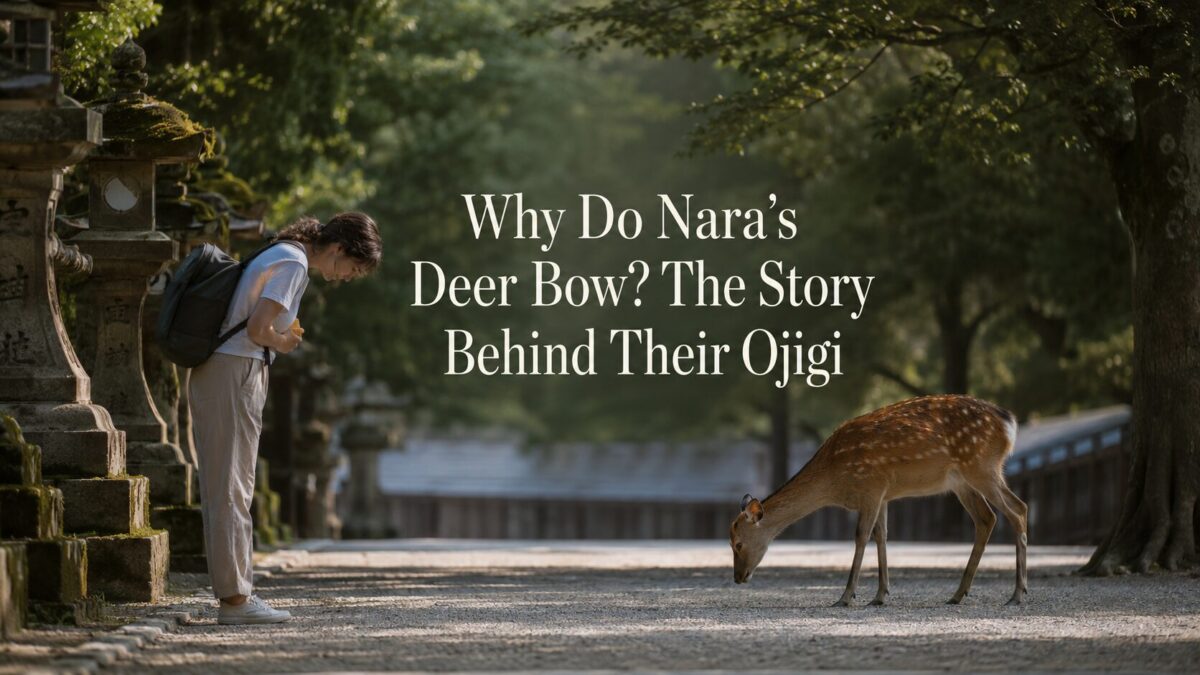
While walking through Nara Park, you may see a deer approach and lower its head as if greeting you.
When a person gives a small bow, the deer may move its head up and down several times in return. Foreign visitors seeing this for the first time often react with surprise and a smile.
Do Nara’s deer understand Japan’s culture of bowing?
It is easy to think so. Their movement closely resembles ojigi, the Japanese custom of bowing to greet someone, express gratitude, or show respect.
But are the deer really saying hello or thank you? Or are they simply asking for a deer cracker?
The bowing behavior of Nara’s deer is connected not only to animal learning, but also to the religion and history of the ancient city of Nara—and to a relationship between people and deer that has continued for more than 1,000 years.
- Do Nara’s Deer Really Bow?
- Why Are There So Many Deer in Nara?
- For Centuries, the Deer Were Protected
- The Bow May Be a Learned Conversation
- Realities and Respect: Nara’s Deer Are Still Wild Animals
- A Local Perspective: An Easy Day Trip from Osaka
- What to Eat in Nara
- More Than a Bow: A Relationship Shaped by History
Do Nara’s Deer Really Bow?
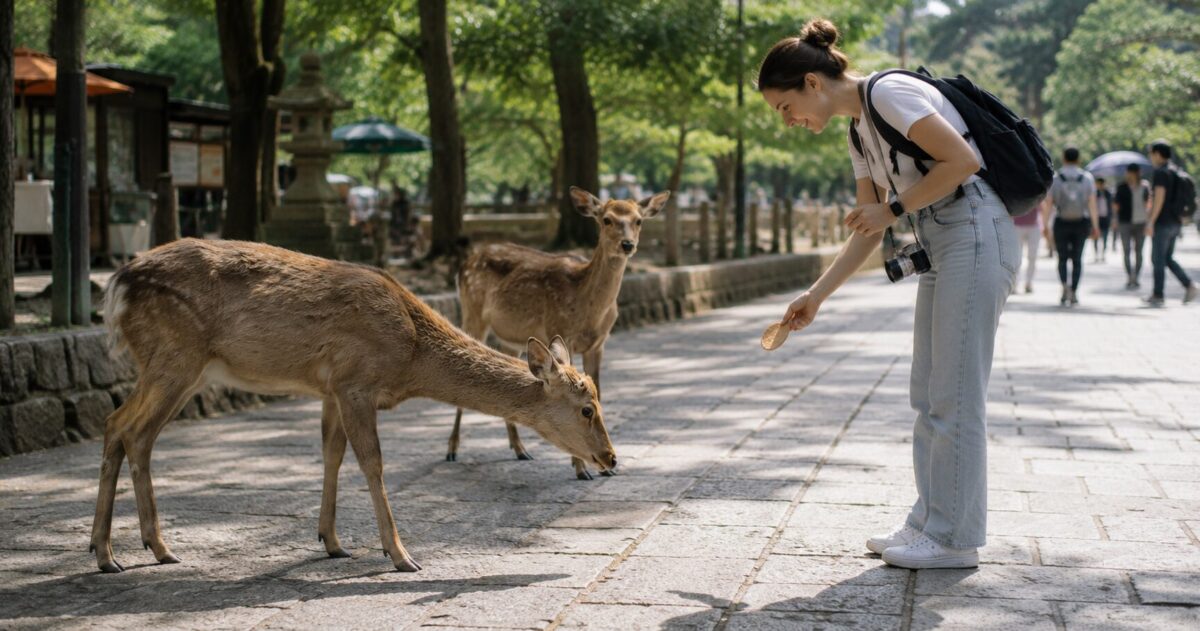
To begin with the answer, Nara’s deer are not believed to bow in order to express gratitude in the same way humans do.
For the deer, the movement is closer to a request:
“Please give me a deer cracker.”
Research conducted at Nara Women’s University observed deer moving their heads up and down in front of people holding deer crackers. The study found that deer that bowed more frequently also tended to receive more crackers.
For the deer, bowing has become an effective way to obtain food.
To human eyes, it may look as though the deer are saying:
“Thank you.”
But from the deer’s perspective, the message may be closer to:
“Can I have the cracker?”
Research has also suggested that the meaning intended by the deer and the meaning understood by humans are not exactly the same.
The deer may lower their heads as a request, while people often interpret the movement as a greeting, an expression of thanks, or a sign of good manners.
In other words, the deer and the humans may be having slightly different conversations, even while watching the same movement.
Why Are There So Many Deer in Nara?
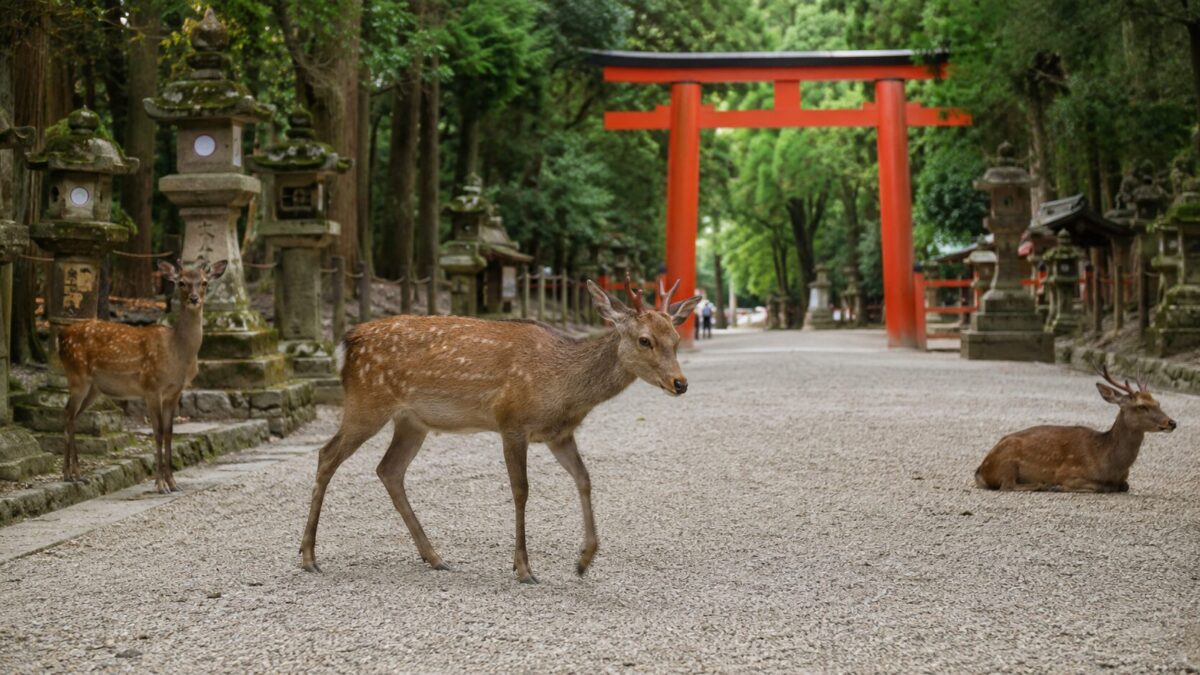
The deer in Nara Park are not kept in a zoo or raised on a farm.
Because they are so accustomed to people, it can be easy to forget that they are wild Japanese sika deer living freely in and around the park.
Today, around 1,300 deer live in the area centered on Nara Park. It is unusual, even on a global scale, to see so many wild animals living so close to temples, shrines, residential areas, roads, and pedestrian paths.
To understand why there are so many deer in Nara, we need to go back to ancient history.
Nara is one of Japan’s oldest capitals. In 710, the capital was established there under the name Heijo-kyo. Ancient temples and shrines such as Todai-ji, Kofuku-ji, and Kasuga Taisha still stand around Nara Park today.
Of these, Kasuga Taisha is especially closely connected to the history of Nara’s deer.
According to a tradition associated with the shrine, the deity Takemikazuchi-no-Mikoto was invited from Kashima in Hitachi Province to Mount Mikasa in Nara during the Nara period. He is said to have arrived riding a white deer.
Because of this story, deer came to be regarded as sacred messengers accompanying the gods. They were known as shika, or sacred deer, and were treated with special respect.
The sight of deer walking along roads or resting in front of temples in modern Nara Park is rooted in this ancient belief.
For Centuries, the Deer Were Protected
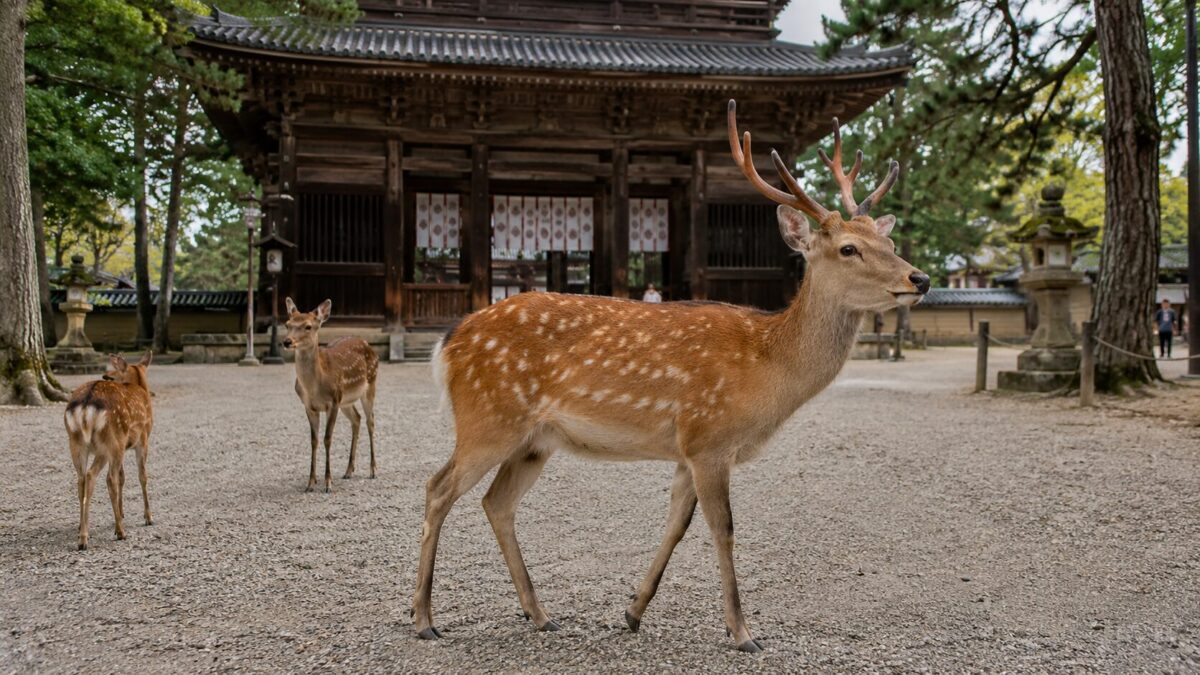
Because they were considered messengers of the gods, Nara’s deer were protected as special animals for centuries.
The exact systems and conditions changed over time, but it is said that harming or killing a deer once carried extremely severe punishment.
The deer were not viewed simply as wild animals. They were connected to the sacred grounds and religious authority of Kasuga Taisha.
Modern genetic research also suggests that this religious and social protection may have helped preserve Nara’s deer over a very long period.
As deer populations in surrounding areas declined because of hunting and land development, the deer of Nara Park survived under human protection. Researchers believe that this allowed them to retain ancient genetic characteristics.
Nara’s deer do not merely appear in old legends.
Their bodies may also carry evidence of more than 1,000 years of coexistence between people and deer.
The Bow May Be a Learned Conversation
The behavior most directly connected to the modern bow is the experience of receiving food from people.
Deer crackers are believed to have been sold in Nara by at least the Edo period. Over many generations, as large numbers of people fed crackers to the deer, the animals likely learned how humans responded to their movements.
A deer lowers its head in front of a person.
The person interprets the movement as a bow and gives the deer a cracker.
The deer learns that lowering its head makes it more likely to receive food.
As this interaction is repeated, the bow-like movement may gradually become established behavior.
Even within Nara Park, deer living in areas with more human contact have been observed bowing more frequently.
The bow is therefore a kind of learned conversation between two different species: deer observe humans, and humans respond to the deer.
Realities and Respect: Nara’s Deer Are Still Wild Animals
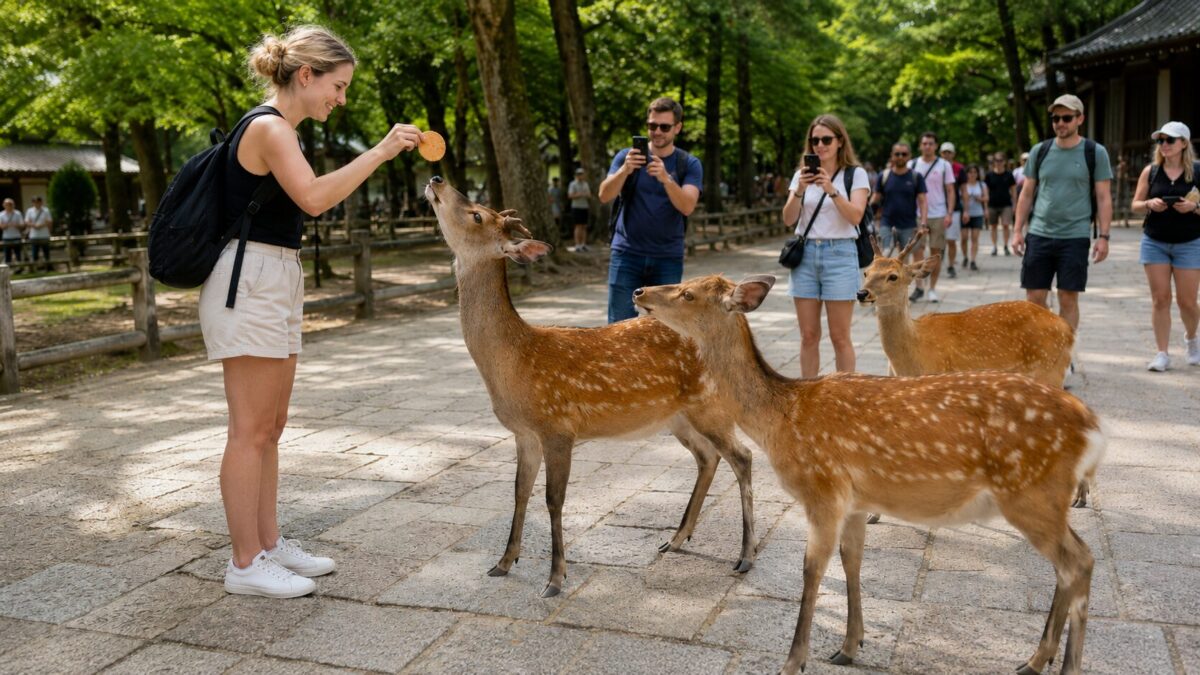
Nara’s deer may be accustomed to people, but they are not pets.
They are wild animals designated as a Natural Monument of Japan.
When someone holds up a deer cracker but delays giving it to them, a deer may pull at clothing, push, or bite.
Extra care is needed around male deer with antlers and female deer protecting their young after giving birth.
When feeding deer crackers, it is best to give them promptly. After all the crackers are gone, showing both empty hands can help the deer understand that you have no food left.
Visitors should not feed the deer human food or anything other than official deer crackers.
Another concern in Nara Park is the accidental swallowing of plastic bags, paper, and other litter. Food packaging, maps, and similar items should not be left exposed near the deer, and all rubbish should be taken away.
Visitors should also avoid touching fawns.
The common explanation that a mother will always abandon a fawn if it carries a human scent is not necessarily accurate. However, the mother may be nearby, and approaching the fawn can frighten the animals or lead to defensive behavior.
The Nara City Tourism Association also asks visitors not to startle the deer or tease them by pretending to offer crackers.
Because the distance between people and deer is so small in Nara, visitors also have a responsibility to behave with restraint.
A Local Perspective: An Easy Day Trip from Osaka
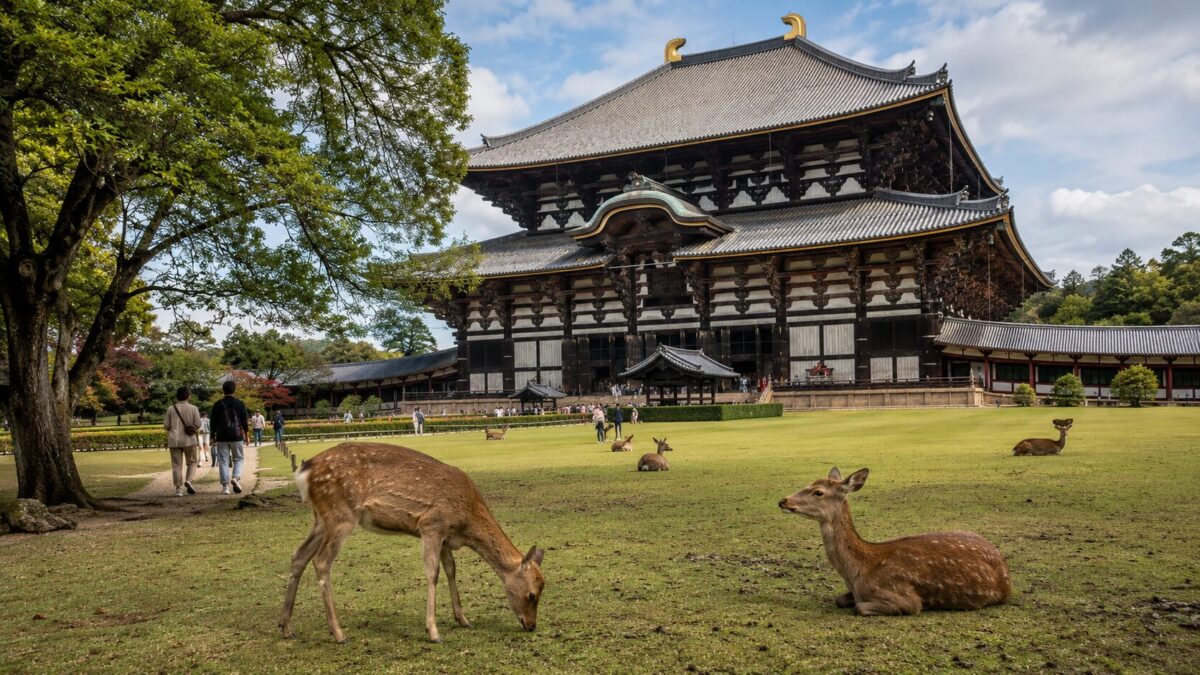
I live in Osaka, so I have visited Nara Park and Todai-ji many times.
Osaka and Nara are in different prefectures, but they are not especially far apart.
From Osaka-Namba Station, it takes around 40 minutes to reach Kintetsu-Nara Station by rapid express train. From the Umeda area, the journey usually takes around 50 to 60 minutes, including transfers.
Nara is also easy to reach from Kyoto, making it a convenient day trip to include in a wider Kansai itinerary.
Even after living in the region, I still find it slightly surprising that you can leave Osaka’s busy shopping and entertainment districts and, about an hour later, arrive among ancient temples and freely roaming deer.
Todai-ji Temple
When visiting Nara Park, the Great Buddha at Todai-ji is difficult to miss.
Even if you have seen it many times in photographs, looking up at the statue inside the Great Buddha Hall is a completely different experience. Its scale is overwhelming.
The hall itself is also remarkable as an enormous wooden structure. After spending time with the deer in Nara Park, visiting Todai-ji helps reveal that this area is not simply a park, but was once one of the religious and political centers of ancient Japan.
Kasuga Taisha
To understand the history of Nara’s deer more deeply, it is worth walking to Kasuga Taisha.
Its vermilion buildings, rows of stone lanterns in the forest, and hanging bronze lanterns create a quiet atmosphere that feels very different from the open spaces of Nara Park.
After learning that deer were protected as sacred messengers, you may see the animals walking along the shrine paths in a slightly different way.
Kofuku-ji and Isuien Garden
Kofuku-ji stands between Kintetsu-Nara Station and Nara Park.
Known for its five-story pagoda, it is easy to visit either at the beginning or the end of a walk through central Nara.
For a quieter experience, Isuien Garden near Todai-ji is also worth visiting.
Its ponds, carefully designed landscape, and views of the surrounding hills offer a calm contrast to the busier deer-filled areas of the park.
What to Eat in Nara
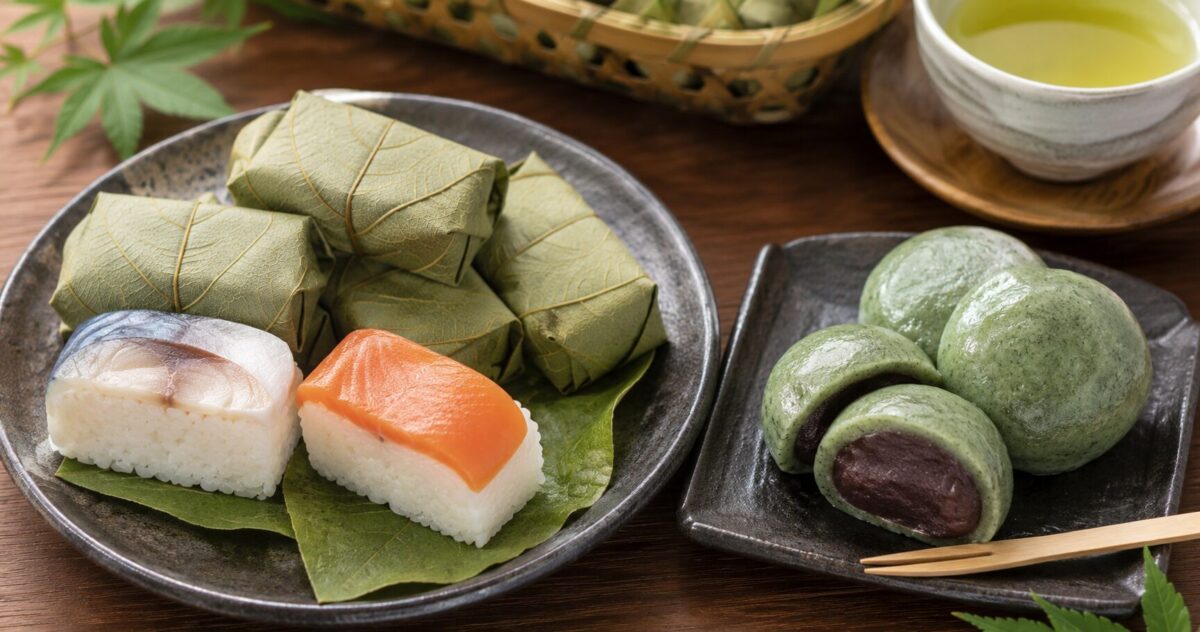
The area around Nara Park also offers several foods associated with the region.
Trying something local between temple and shrine visits can make a day trip feel more complete.
Kakinoha Zushi
Kakinoha zushi is one of Nara’s best-known traditional foods.
It consists of vinegared rice topped with fish such as mackerel or salmon, then wrapped in a persimmon leaf.
The leaf is not usually eaten, but it gives the sushi a subtle aroma when the wrapping is opened.
The dish developed partly as a way to preserve fish in inland Nara, which is surrounded by mountains. Because it is compact and easy to carry, it also works well as lunch or as a snack for the train journey home.
Yomogi Mochi at Nakatanidou
On the way from Kintetsu-Nara Station toward Nara Park, many visitors stop at Nakatanidou.
The shop is known for its rapid mochi-pounding performances. When the timing is right, visitors can watch the mochi being pounded at high speed to the rhythm of energetic shouts.
Freshly made yomogi mochi is soft and chewy, with the aroma of mugwort, sweet red bean paste inside, and a coating of roasted soybean flour.
Nara’s Shaved Ice
Nara is strongly associated with ancient temples and deer, but in recent years it has also become known for shaved ice.
Himuro Shrine, near Nara Park, has a long historical connection with the storage and worship of ice. Against this background, a growing number of shops in Nara now serve creative varieties of kakigori.
Alongside traditional flavors such as matcha and sweet red beans, some shops use fruit, tea, and other ingredients produced in Nara Prefecture.
It is an especially welcome treat after walking around Nara during the hot summer months.
More Than a Bow: A Relationship Shaped by History
Nara is easy to visit from both Osaka and Kyoto, and its temples, shrines, gardens, local food, and wildlife can all be experienced in a single day.
When visiting, it is important to remember that the deer are wild animals.
Do not tease them with crackers, leave food or rubbish behind, or touch the fawns.
Respect from the human side is also part of protecting the relationship between people and deer that has continued in Nara for centuries.