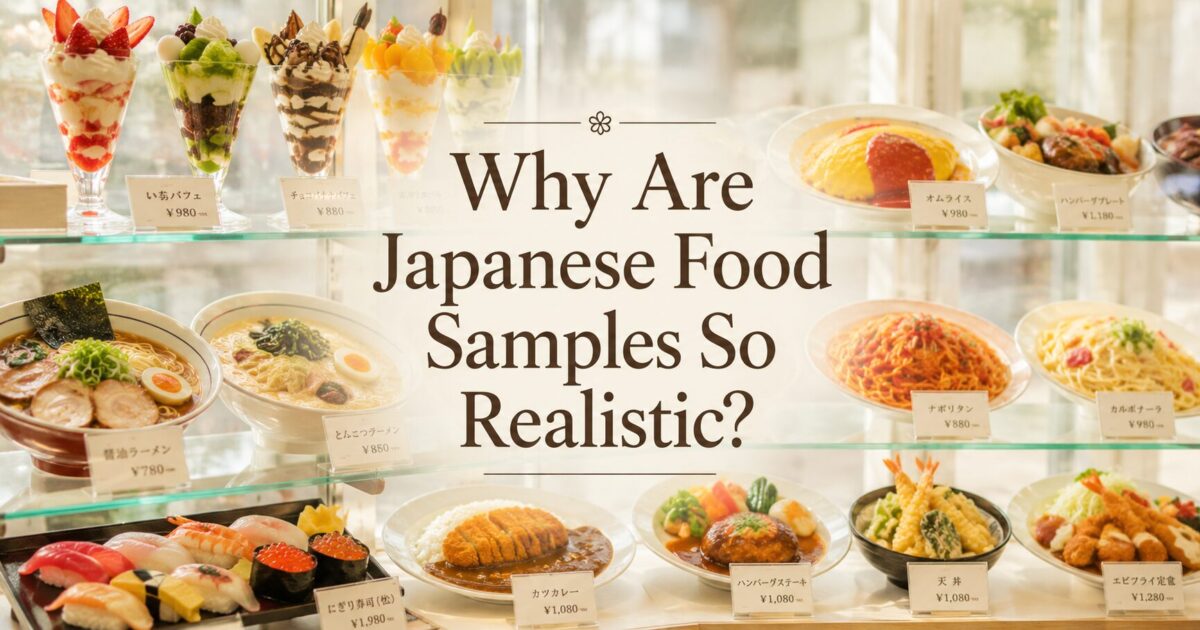
Some first-time visitors to Japan are surprised when they see the dishes displayed outside restaurants. “I thought they were real,” they may say, or “Are these actual dishes for sale?”
The ramen, sushi, curry, and parfaits arranged inside glass display cases look realistic enough to make you want to reach out and touch them.
Walk through a restaurant district in Japan, and you will often see showcases filled with food near the entrance. Even from close up, the dishes can be difficult to distinguish from the real thing. However, they are all models known as food samples.
Food models also exist in other countries, but in Japan they are more than simple decorations. They developed as practical tools for customer service, designed to explain dishes clearly and help anyone order with confidence.
Why, then, are food samples so widely used in Japan, and why are they made with such extraordinary realism?
What Are Food Samples Used For?
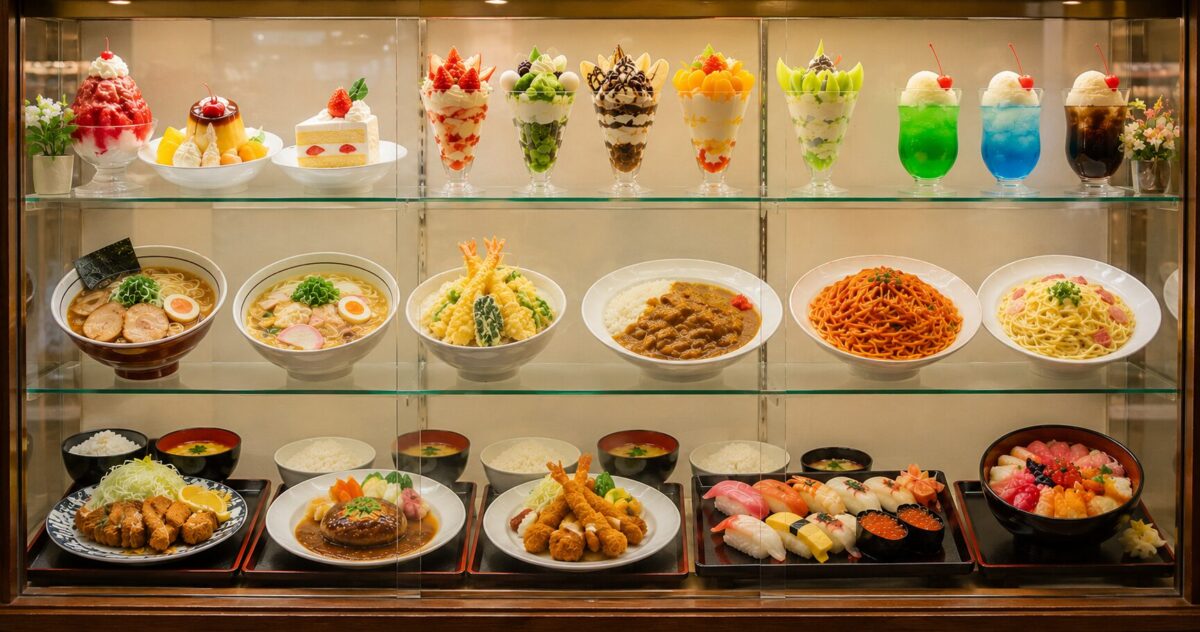
The main purpose of food samples is to show customers what a dish looks like before they enter the restaurant.
A menu name alone may not tell someone very much. With a realistic model, however, customers can immediately understand what kind of dish it is, how large the portion may be, how it is presented, and whether it seems worth the price.
This is useful not only for Japanese customers, but also for international visitors who cannot read Japanese or are unfamiliar with local dishes.
Even without knowing the name of a dish, a customer can simply point and say, “I would like this one.” In that sense, food samples function as a visual menu that does not depend on language.
They Developed Alongside Japan’s Modern Dining Culture
The spread of food samples was closely connected to the growth of Japan’s modern restaurant industry.
As department-store dining halls and Western-style restaurants became popular, new dishes such as Japanese curry rice, omurice, and spaghetti began appearing on menus. At the time, many customers were unfamiliar with these foods.
A name alone was not always enough to explain what the dish looked like.
Restaurants therefore began displaying models of completed meals so that customers could see what they were ordering. This system allowed people to choose with greater confidence and was gradually adopted by many restaurants. Food samples eventually became a familiar part of Japan’s dining culture.
There are several theories about the origins of Japanese food samples, so it is difficult to identify a single inventor. Rather, the culture is thought to have developed through the ideas and techniques of craftspeople in different places.
Made by Taking Molds from Real Food
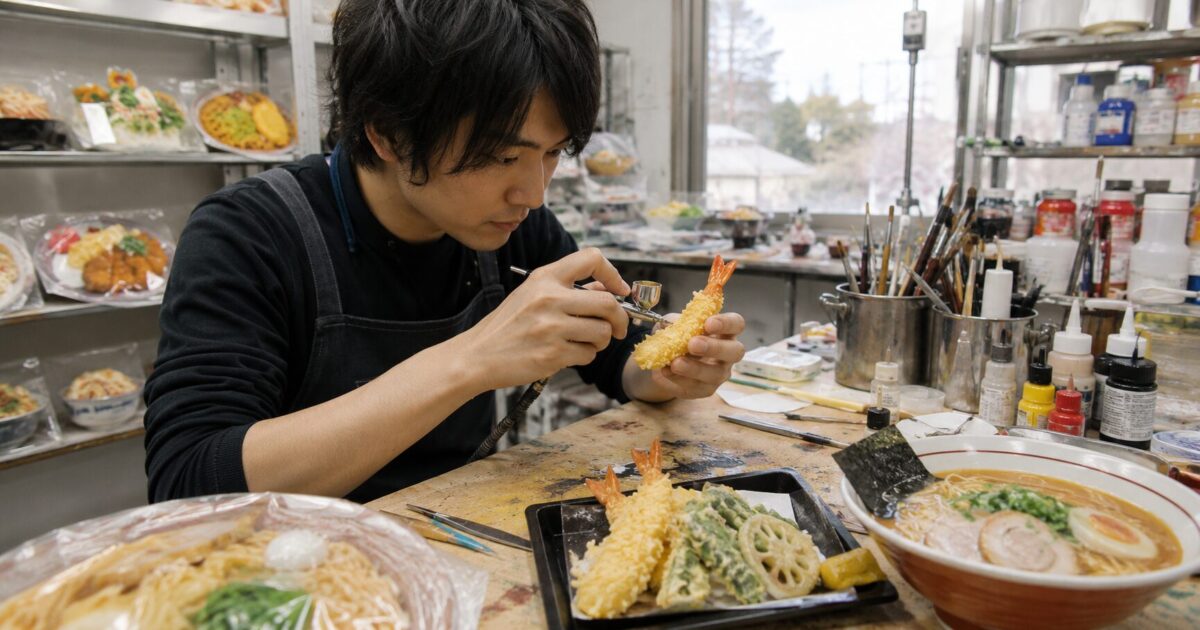
The realism of Japanese food samples begins with careful observation of actual dishes.
In the past, wax was the main material. Today, synthetic resin is more commonly used because it is more durable and allows for a wider range of colors and textures.
The basic production process usually involves the following steps:
1. Taking a mold from real food
2. Pouring resin into the mold
3. Removing the hardened pieces
4. Painting each piece by hand
5. Arranging everything like the finished dish
Craftspeople reproduce even the smallest details, including grill marks, the shine of oil, the texture of rice grains, the fibers of vegetables, and the way sauce flows across a plate.
Making a food sample is not simply a matter of copying a meal. The goal is to recreate the moment when the dish looks most appetizing. That requires close observation, technical skill, and a strong sense of presentation.
“Silent Service” That Reduces the Anxiety of Ordering
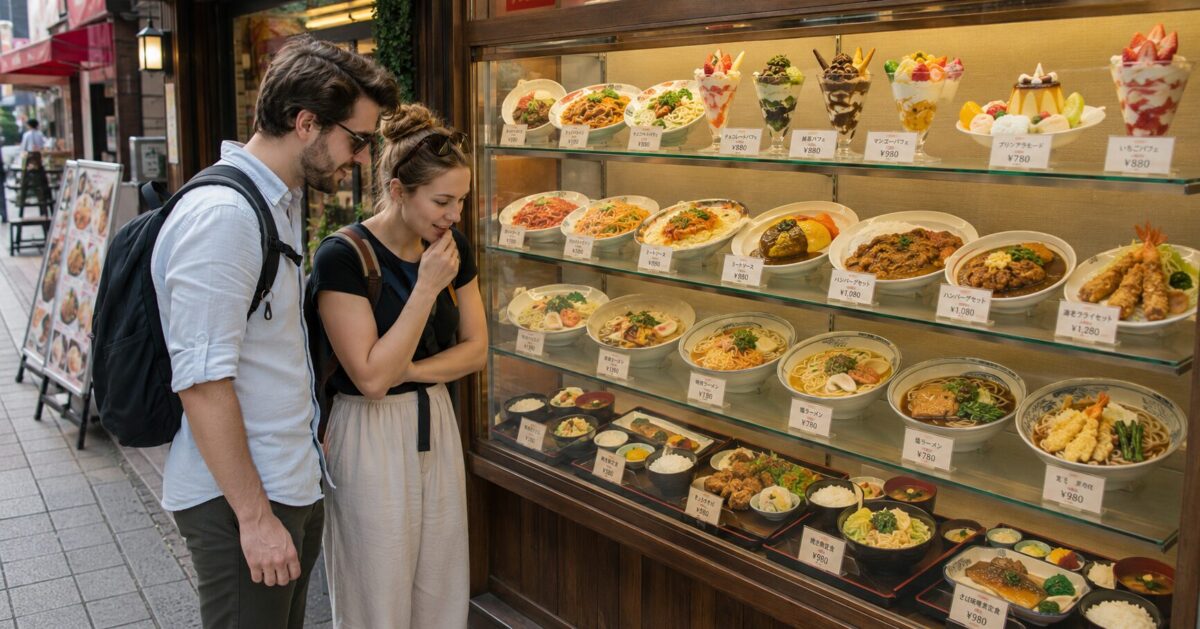
Food samples are also closely connected to Japan’s service culture.
Because customers can check the dish and its price before entering, they are less likely to worry that the meal will look different from what they expected or that the portion will be larger than imagined.
Customers can choose for themselves without requiring a detailed explanation from the staff, reducing the burden on both sides.
For international visitors in particular, food samples can be seen as a form of universal design that crosses language barriers.
They allow people to understand a dish and order with confidence without exchanging many words. In this sense, they provide a kind of “silent service.”
Japan has many systems designed to help people use services without confusion, including vending machines, menus with photographs, and clear signs in railway stations. Food samples developed as part of this same approach.
Behind them is a service culture that tries to make information clear before users encounter a problem and anticipates what they may need in order to avoid confusion.
From Practical Display to Cultural Icon
Today, food samples have moved beyond their original role as restaurant displays and have become recognizable items of Japanese popular culture.
Miniature food samples are sold as keychains, magnets, smartphone accessories, stationery, and souvenirs. Products modeled on realistic Japanese food are popular with both domestic and international visitors.
Workshops around Japan also offer food-sample-making experiences. One example is Design Pocket in Osaka’s Namba area. Some facilities provide multilingual guidance, including English, as well as tablet-based support, making the experience accessible to international travelers.
At the same time, some restaurants now use fewer food samples because menus with photographs and digital signs are easier to update.
Even so, three-dimensional models have a presence and immediate clarity that photographs cannot fully reproduce. Japanese food samples remain a familiar part of the streetscape because they can communicate a dish at a glance.