For many people outside Japan, the word gacha may first bring to mind the randomized reward systems found in mobile games.
But walk through a Japanese city, and you will encounter a physical version of that idea almost everywhere.
Insert a coin. Turn the handle. A small capsule drops out, and you do not know exactly what is inside until you open it.
Gachapon machines can be found in train stations, shopping malls, game centers, electronics stores, and airports. In Japan, they are not confined to toy shops. They have quietly become part of everyday public space.
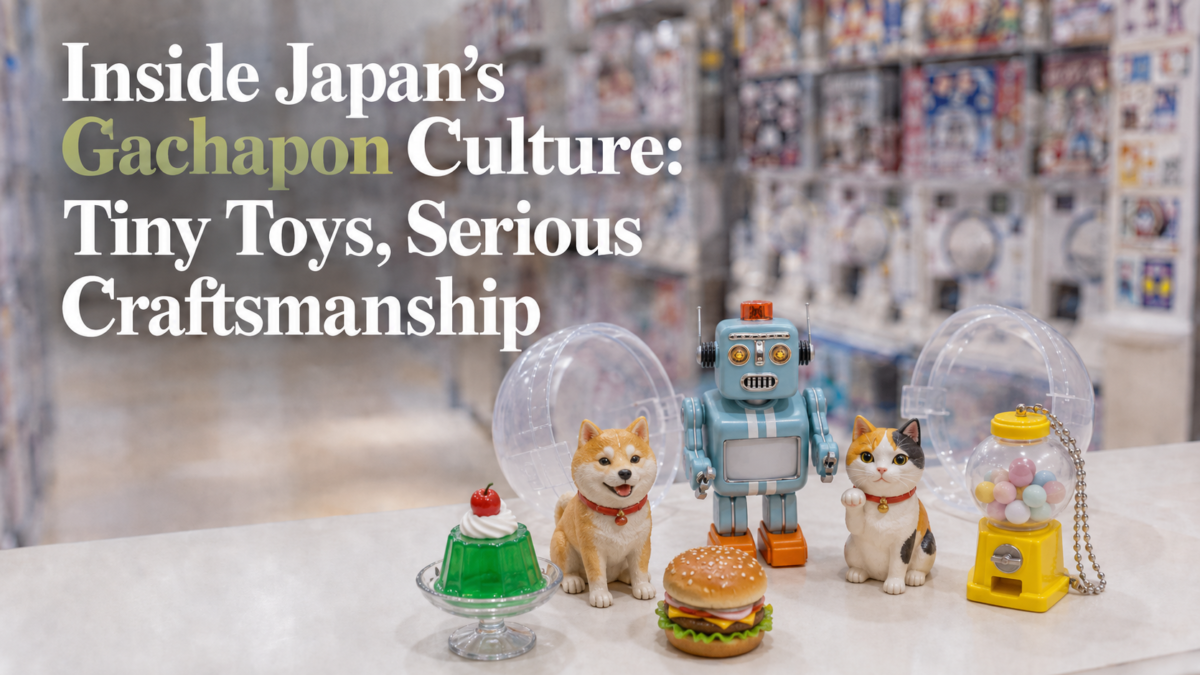
And the contents are not always simple children’s toys.
Alongside anime and manga characters, you may find miniature food, stationery, furniture, household appliances, animals, and tiny replicas of real products.
Many are surprisingly detailed for something that costs only a few hundred yen.
So why does Japan put so much effort into such small toys?
To understand that, it helps to look at the history of gachapon, the manufacturing behind them, Japan’s miniature and character culture, and even newer capsule-less designs.
From American Machines to a Japanese Gacha Culture
Gachapon was not invented entirely from scratch in Japan.
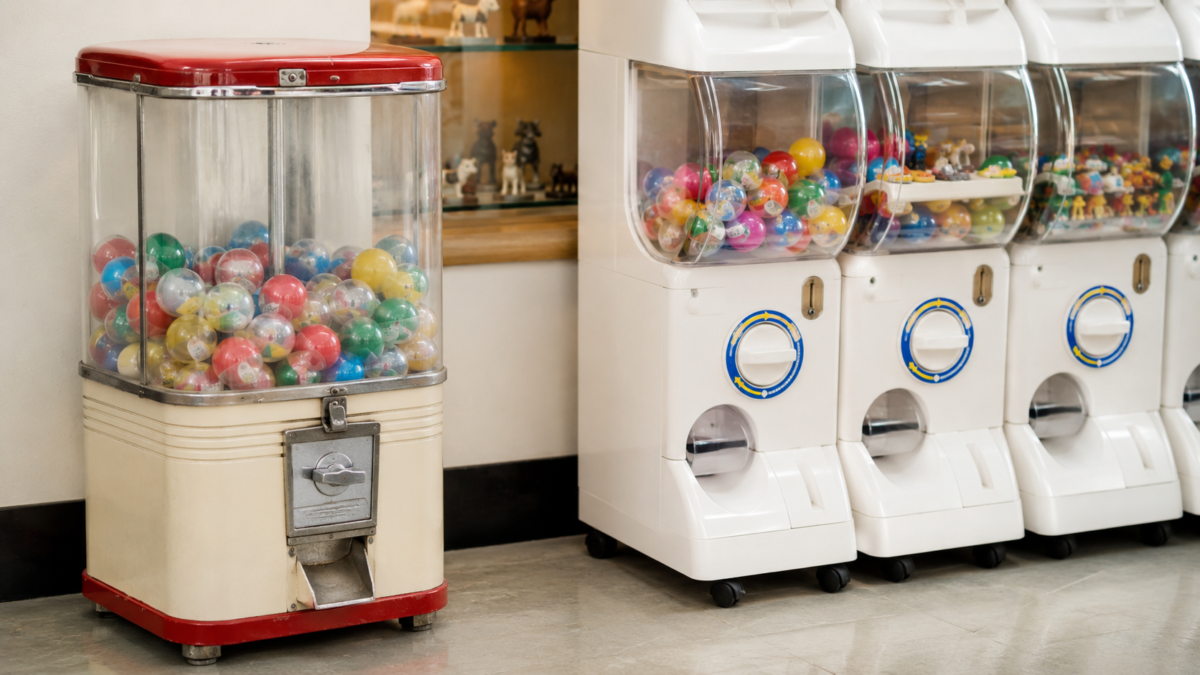
According to Takara Tomy Arts, capsule toy sales in Japan began in 1965, when Penny Shokai imported machines from the United States and introduced them to the Japanese market.
Early machines were often placed outside toy shops, dagashi snack stores, and stationery stores, where they mainly sold inexpensive toys for children.
Later, Japanese toy companies began developing the format in their own way.
Bandai entered the capsule toy market in 1977 and named its own brand GASHAPON.
The name comes from Japanese sound effects: gasha for the sound of turning the handle, and pon for the capsule dropping out.
Today, English speakers may see several terms, including gachapon, gashapon, gacha, and capsule toy.
“GASHAPON” is Bandai’s brand name, while “gacha” is also used by Takara Tomy Arts and more broadly in everyday Japanese usage.
The basic mechanism came from overseas.
But over decades, the products, presentation, and culture surrounding the machines developed in distinctly Japanese directions.
How Gachapon Grew Up With Its Audience
Older gachapon machines were strongly associated with cheap children’s toys.
Look at what is sold today, however, and the picture is very different.
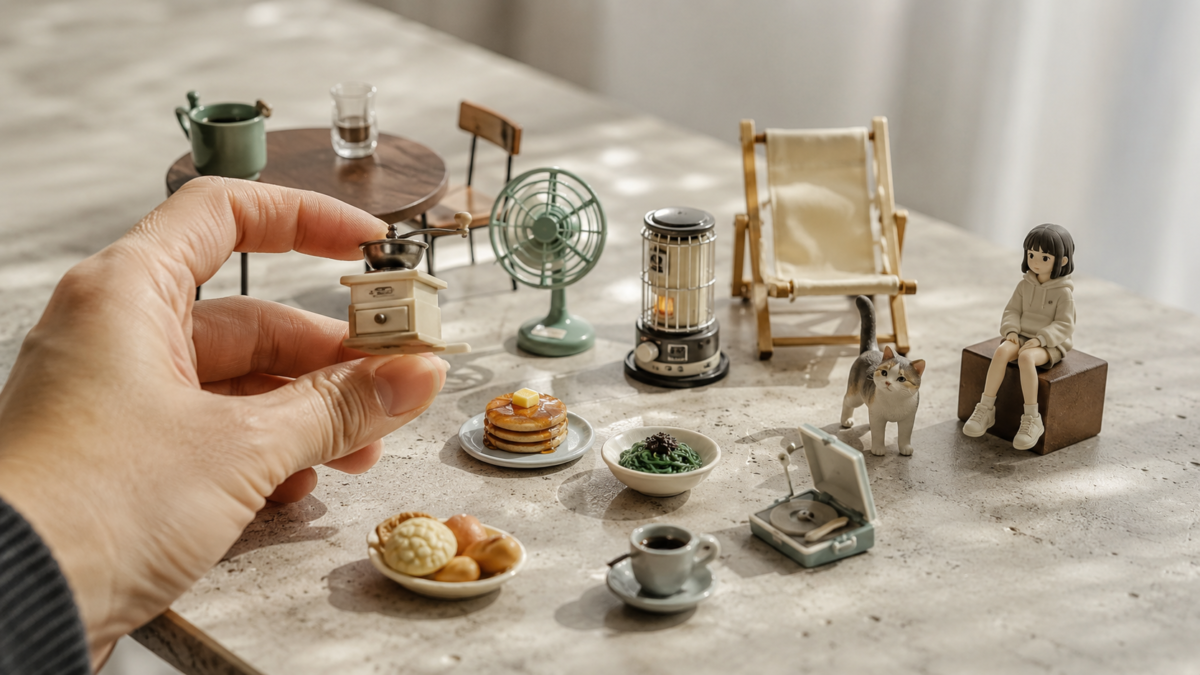
Alongside anime, manga, and game characters, there are animals, miniature food, stationery, furniture, nostalgic household objects, and strange original creations that seem designed as much for adults as for children.
Bandai Namco now releases more than 1,200 Gashapon products a year, with some product lines rotating within only a month or two.
The audience has also expanded.
Some gachapon are designed as display pieces. Others recreate nostalgic products or everyday objects that adults recognize from childhood.
This is less a story of adults simply continuing to buy children’s toys and more a story of the products themselves growing up with their audience.
A miniature of an old food package or household item may look novel to a child, but to an adult it can trigger a memory.
The same tiny object can therefore appeal to different generations for completely different reasons.
That flexibility is one reason gachapon has remained part of Japanese popular culture for so long.
When Everyday Japan Becomes a Miniature
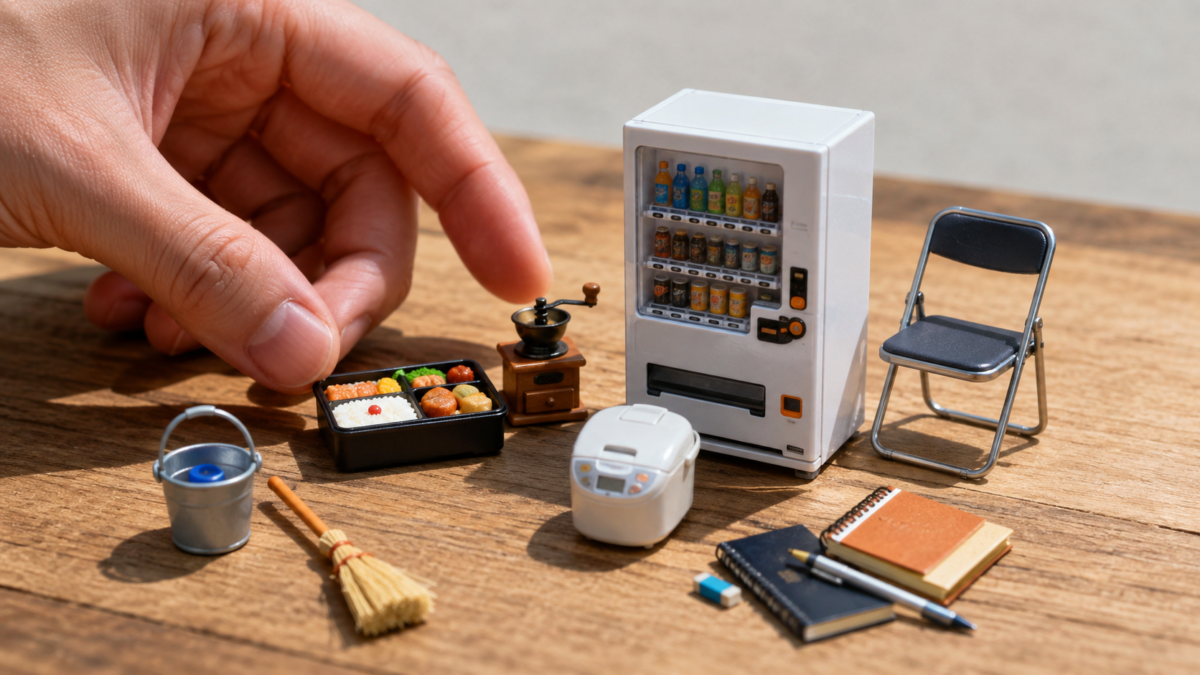
Another striking part of gachapon culture is the sheer variety of subjects.
Outside Japan, people may associate gachapon mainly with anime or manga characters.
Those are certainly a major category.
But ordinary things are also turned into miniatures.
Food. Drinks. Stationery. Furniture. Appliances. Coffee equipment. Vending machines. Old household goods.
Sometimes the most surprising products are the ones that make you ask, “Why did someone decide to make this tiny?”
The appeal is not only that the object is small.
When a real product is recreated, simply making something that looks vaguely similar is not enough.
Its shape, color, proportions, packaging, and recognizable details all contribute to the feeling that you are looking at a miniature version of the real thing.
That is why official collaborations with real companies can work so well.
The value comes from being able to look at a tiny object and immediately recognize what it is supposed to be.
Reducing an ordinary object to a small scale can also change how we look at it.
A food package, a piece of station equipment, or an everyday household object can suddenly feel collectible once it fits in the palm of your hand.
Anime, manga, and game characters add another layer.
Randomness works naturally with collecting.
You may not get the character you want on the first try.
So you turn the handle again.
The uncertainty of what will appear—and the desire to complete a set—becomes part of the experience.
In gachapon, the act of collecting is almost as important as the toy itself.
Why Gachapon Is Everywhere — And Where Travelers Can Try It
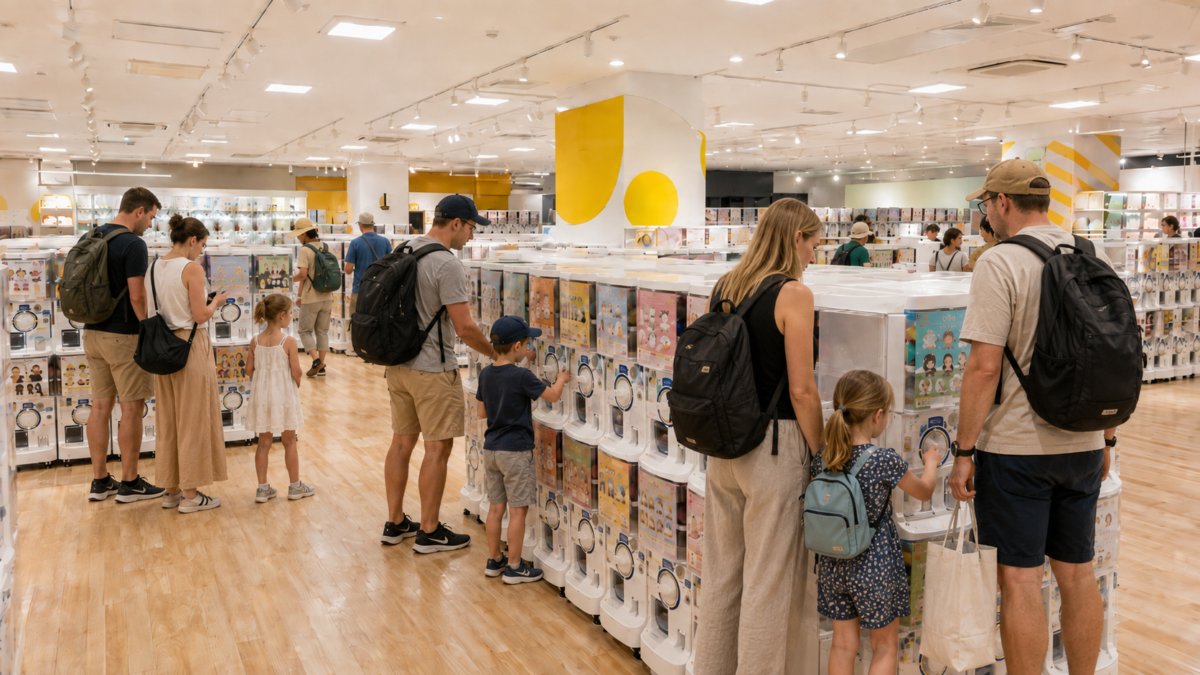
Gachapon machines used to be something you might see in a corner near the entrance of a shop.
That has changed.
Today, there are large specialist stores where gachapon itself is the reason people visit.
Some contain hundreds or even thousands of machines.
In 2021, Bandai Namco opened the Gashapon Department Store Ikebukuro Main Store with 3,010 machine slots, and it was recognized at the time by Guinness World Records as one of the world’s largest capsule toy stores.
The shift is significant.
Gachapon has moved from a small amusement in the corner of a shop to a destination in its own right.
In Tokyo, Akihabara and Ikebukuro are two easy places to see this modern gachapon culture.
Akihabara connects gachapon naturally with anime, gaming, and hobby culture.
Ikebukuro shows what happens when a capsule toy store becomes large enough to function almost like a department store.
In Osaka, large gachapon sections can also be found around Umeda and Namba.
It is especially interesting to see large capsule toy areas inside electronics stores.
Someone may enter to buy a camera, wait for a train, or simply pass through while shopping—and still stop to turn a gachapon handle.
That tells us something important about their place in Japan.
Gachapon no longer belongs only in toy stores.
It can appear wherever people move through everyday urban space: stations, malls, electronics stores, airports, and entertainment facilities.
Japan’s vending machines are usually about convenience, while gachapon machines turn a similarly simple mechanical action into entertainment.
A single gachapon purchase is small.
But inside that small capsule are pieces of Japan’s toy industry, industrial design, character culture, love of miniatures, collecting habits, randomness, and even newer attempts to reduce waste.
Perhaps the most interesting thing is that small does not mean simple.
Turning the handle takes only a few seconds.
But behind the capsule that drops out are far more ideas, design decisions, and manufacturing constraints than you might expect.
A gachapon capsule may be small, but the culture packed inside it is surprisingly large.