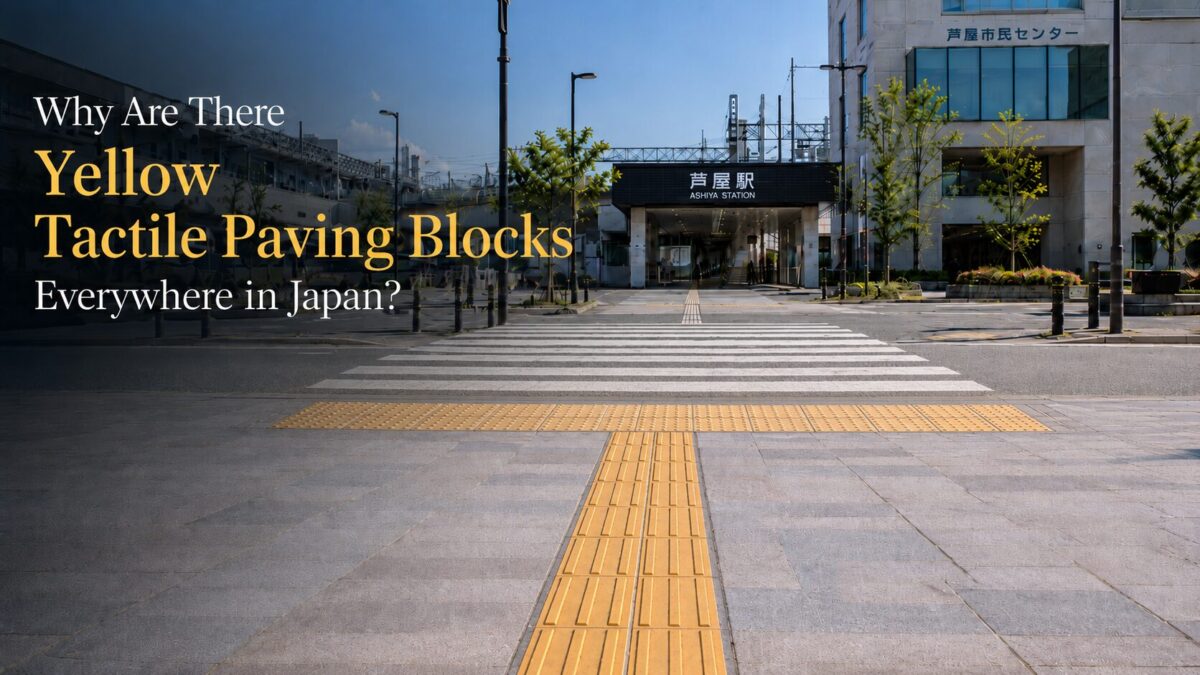
Train platforms, the edges of crosswalks, sidewalks, and the entrances to public buildings.
Across Japan, bright yellow blocks connect many parts of the city.
Some international visitors notice them almost immediately and wonder why they appear so often. At first, they may look like decoration, lane markings, or a distinctive feature of Japanese streets.
But once you understand their purpose, they reveal a different side of Japan’s public infrastructure.
These blocks are commonly called *tenji blocks* in Japan. In English, they are usually described as **tactile paving**, **yellow braille blocks**, or more formally, **Tactile Ground Surface Indicators**, often shortened to **TGSIs**.
They help people with visual impairments navigate by providing information that can be felt through the soles of the feet or with a white cane.
For most people in Japan, these yellow paths are so familiar that they are rarely noticed.
For someone with limited or no vision, however, they can communicate direction, danger, and changes in the surrounding environment.
Tactile paving is not simply decoration embedded in the pavement.
It is a guidance system designed to be read by touch.
Lines and Dots Communicate Different Messages
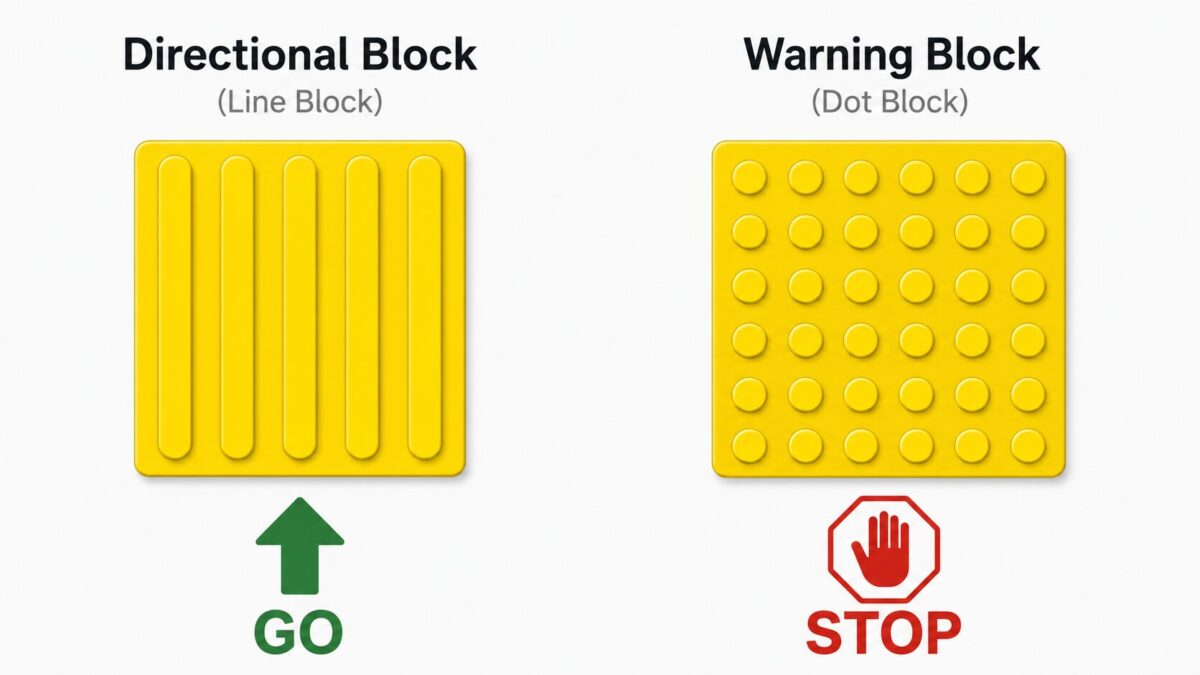
There are two main types of tactile paving in Japan.
The first is the **line block**, also known as a **directional block**.
It contains long raised bars arranged in parallel. The direction of the bars shows the direction of travel.
A person can follow these raised lines toward a station gate, staircase, elevator, building entrance, bus stop, or another important destination.
The second type is the **dot block**, also called a **warning block**.
It has a surface covered with raised circular bumps. These dots indicate that the person should stop, slow down, or carefully check the surroundings.
Warning blocks are commonly installed before stairs, at the edge of crosswalks, near railway platforms, and at junctions where the route changes.
On many Japanese railway platforms, you may also see warning blocks with a single raised line along one side.
This is known as an **inside-line warning block**.
The extra line shows which side is safely inside the platform and which side faces the tracks.
To someone unfamiliar with tactile paving, the different blocks may look almost identical.
In reality, the lines, dots, and their placement each communicate different information.
When international visitors learn this, many are surprised to discover that the yellow blocks are not scattered randomly. They form a carefully planned guidance system across stations and streets.
Why Is Tactile Paving Usually Yellow?
Tactile paving is designed to be detected with the feet or a white cane.
However, not everyone with a visual impairment is completely blind.
Visual impairment includes a wide range of conditions. Some people can still recognize light, color, contrast, or the outlines of objects.
For this reason, tactile paving must also be visually distinguishable from the surrounding surface.
In Japan, yellow is generally used because it creates a strong contrast with gray sidewalks, dark roads, and many station floors.
This contrast helps people with partial sight locate the blocks using their remaining vision.
Yellow is not used simply because it is bright or visually striking.
It serves a practical purpose.
In some locations, another color may be used when yellow does not provide enough contrast with the surrounding floor.
The most important point is not that the block must always be yellow, but that it must be easy to distinguish from the surface around it.
Tactile paving therefore communicates through both touch and sight.
Its color is part of the accessibility system.
Tactile Paving Was Invented in Japan
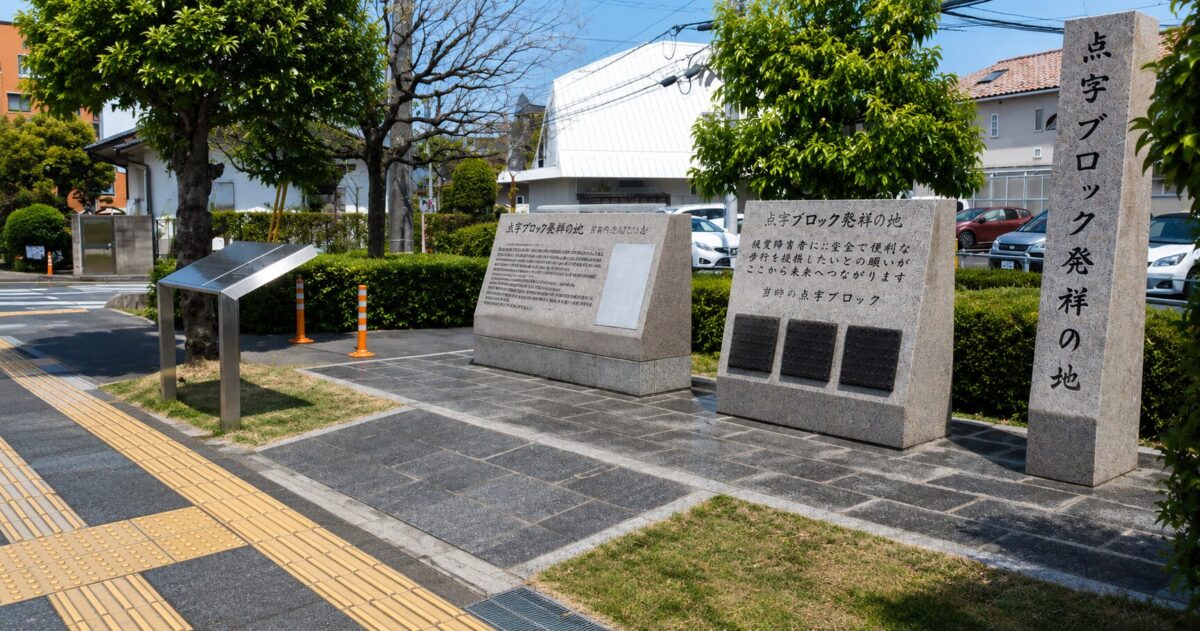
Tactile paving is a Japanese invention.
It was developed in 1965 by Seiichi Miyake in Okayama Prefecture.
On March 18, 1967, the world’s first tactile paving blocks were installed near the Okayama School for the Blind.
At the time, ideas such as universal design and barrier-free public spaces were not yet widely recognized in Japan.
The blocks did not spread across the country immediately.
Over time, however, their importance became better understood.
They began appearing at railway stations, on sidewalks, and around public facilities. Standards were later developed for their shape, placement, and use.
Today, similar tactile ground surface indicators can be found in many countries.
International visitors are often surprised to learn that the yellow paths they see across Japanese cities began with one person’s idea in Okayama.
What now looks like an ordinary part of the Japanese streetscape eventually became an accessibility system used around the world.
The Yellow Paths Form Connected Routes Through the City
Tactile paving is not installed as a collection of isolated blocks.
It is intended to form a continuous route between important places.
At a railway station, directional blocks may lead from the entrance to ticket machines, ticket gates, stairs, elevators, and platforms.
On sidewalks, they may connect stations, bus stops, public buildings, and crosswalks.
Directional line blocks guide movement along a route.
At turns, intersections, stairs, crossings, or other areas requiring attention, they change to warning dot blocks.
Tactile paving also works alongside other accessibility features.
Audible traffic signals, station announcements, braille signs, elevators, platform gates, and white canes all provide different forms of information.
To a visitor walking through a Japanese city, the yellow strip may seem to continue for an unusually long distance.
That is intentional.
It is designed to help someone travel from one point to another rather than simply identify a single dangerous location.
However, tactile paving alone cannot make every journey completely safe.
Some routes end unexpectedly. Others may be confusing or poorly placed. Railway platforms and level crossings remain especially challenging environments.
For this reason, tactile paving is not a finished system that never changes.
It is public infrastructure that continues to be reviewed and improved as cities and transport systems evolve.
Why the Yellow Path Must Not Be Blocked
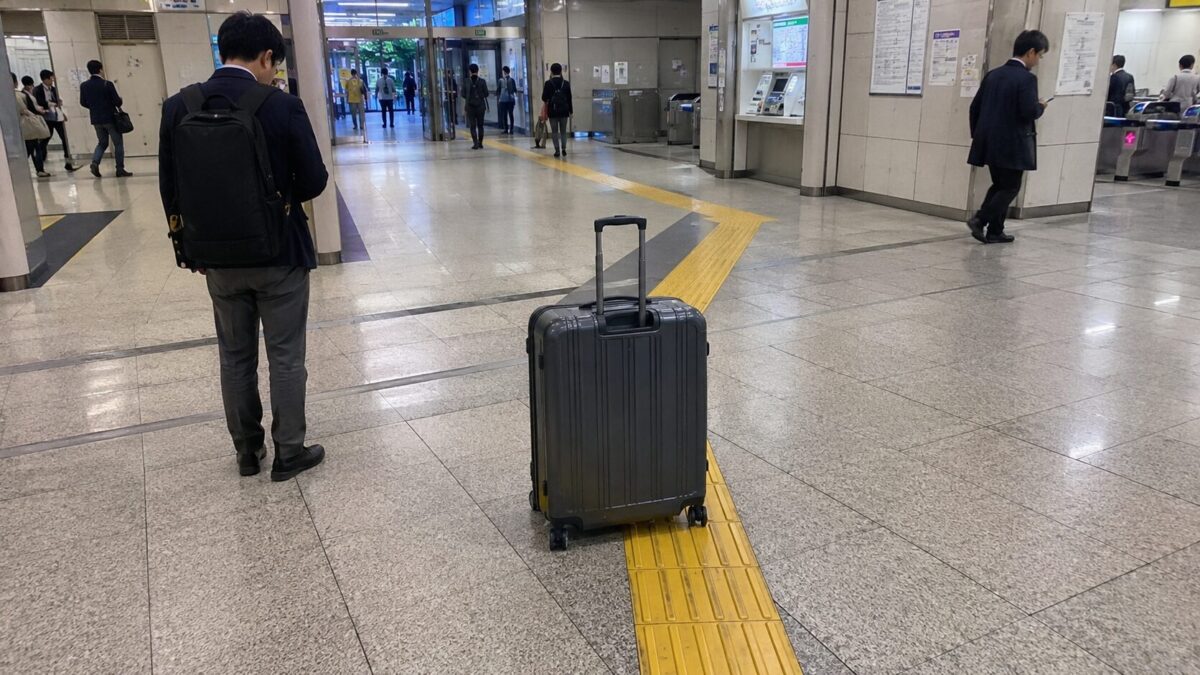
It is not unusual to see bicycles, signs, luggage, or other objects placed on tactile paving.
At busy stations, someone looking at a smartphone may stop on the blocks without realizing it.
Travelers with large suitcases may also leave their bags directly across the route.
These actions may seem harmless.
But people with visual impairments often walk with the expectation that the tactile route will remain clear and continuous.
An unexpected obstacle can cause a collision or fall.
When trying to avoid the object, a person may move toward a road, the edge of a railway platform, or another dangerous area.
Tactile paving is not a convenient place to stand, wait, or store luggage.
It is a pathway.
When you see yellow tactile blocks, understanding their meaning is only the first step.
It is also important to keep them clear.
For visitors traveling through Japan with large bags, a small action can make a real difference.
Moving a suitcase slightly away from the yellow path can help protect someone else’s ability to move safely and independently.